40 to 150 kg depending on the site, from age 12 with parental consent: the conditions for bungee jumping are more accessible than most people think. Six formal medical contra-indications exist, but they affect a small minority of candidates. Weight, age, health, weather: here's what to check before you book.
58 offers Bungee Jumping
Compare offersWeight Limits for Bungee Jumping
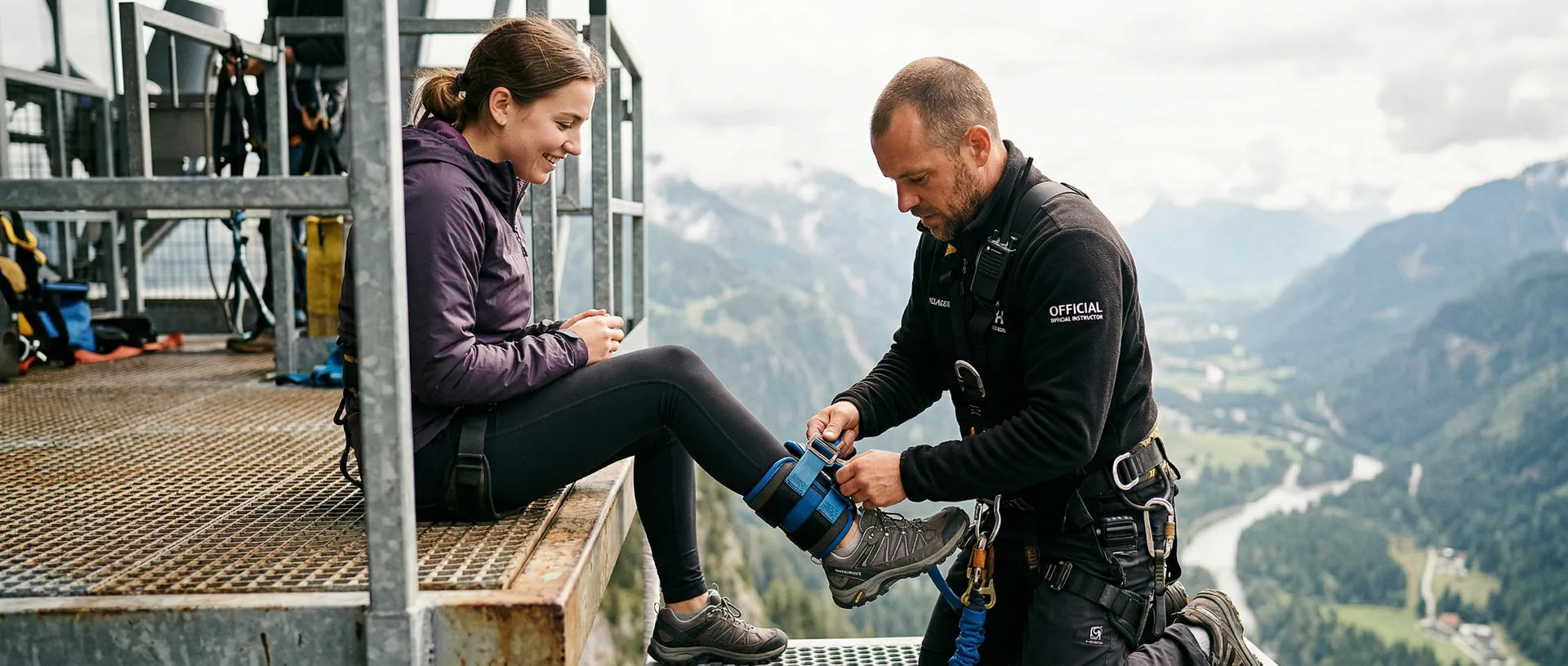
The bungee cord is calibrated individually for each jumper: your weight determines the cord type and its tension. That's why every site has a weight range, checked twice before you jump.
| Country | Site | Height | Min weight | Max weight |
|---|---|---|---|---|
| France | Gorges du Verdon (Pont de l'Artuby) | 182 m | 50 kg | 130 kg |
| France | Viaduc de la Souleuvre | 61 m | 40 kg | 150 kg |
| Switzerland | Verzasca Dam | 220 m | 45 kg | 115 kg |
| Austria | Europabrücke (Innsbruck) | 192 m | 50 kg | 105 kg |
| Spain | Lloret de Mar | 70 m | 40 kg | 175 kg |
| Germany | Hamburg (harbour crane) | 50 m | 50 kg | 118 kg |
Most European sites accept jumpers between 40 and 130 kg. The highest platforms (Verzasca, Europabrücke) are more restrictive: at 192 m or 220 m, the forces on the cord increase significantly.
For a tandem jump, the combined weight should generally not exceed 180 to 260 kg, with a maximum difference of 30 kg between both jumpers.
Minimum and Maximum Age for Bungee Jumping
| Country | Minimum age (solo) | With parental consent | Medical certificate |
|---|---|---|---|
| France | 18 | From 12-13 (if ≥ 40 kg) | Required from age 55-60 |
| Switzerland | 18 | No age minimum (weight-based: 45 kg) | Required from age 65 |
| Austria | 16 | From 14 | General fitness required |
| Spain | 18 | From 12-14 | Required from age 55-60 |
| Germany | 18 | From 16 | Not required |
There is no upper age limit. At AJ Hackett in New Zealand, jumpers over 90 have completed a jump. In Europe, a medical certificate less than 3 months old is the only additional requirement for seniors, typically required from age 55-65 depending on the operator.
Some French sites offer tandem parent-child jumps from age 5, with the child attached to the adult's harness.
Medical Contra-indications for Bungee Jumping
Six conditions are formal contra-indications, cited by all European operators.
1. Pregnancy
Categorical refusal at every site. The sudden deceleration poses a risk to placental stability.
2. Cardiovascular conditions
Angina, arrhythmia, uncontrolled hypertension or history of heart attack. The adrenaline surge puts heavy strain on the cardiovascular system.
3. Epilepsy
Intense stress can trigger a seizure. Neurological clearance is essential.
4. Spinal or cervical injuries
Herniated disc, neck injury or spinal problems. The cord rebound exerts significant forces on the spine.
5. Glaucoma and eye conditions
Intraocular pressure can exceed 100 mmHg during a jump1. Glaucoma, severe myopia and a history of retinal detachment are specific contra-indications, rarely mentioned by operators but documented in medical literature.
6. Recent surgery
Any surgical procedure requires full recovery before jumping.
Three other conditions warrant prior medical advice: unstable diabetes, Meniere's disease and stress-triggered asthma.
If none of these apply to you, you're good to go.
Does Fear of Heights Prevent You from Bungee Jumping?
No. Acrophobia affects 2 to 6% of the population, and most first-time jumpers feel apprehension on the platform. It is not a contra-indication.
The distinction matters: acrophobia is a psychological response, not a medical condition. The only problematic vertigo is caused by inner ear pathology (Meniere's disease), listed in the contra-indications above.
AJ Hackett, the world's leading bungee operator, confirms it: their crews are specifically trained to support fearful jumpers. The approach is straightforward: deep breathing and mental reframing. Fear and excitement produce the same physical symptoms.
Weather Conditions and Bungee Jumping Season
Above 40 km/h sustained wind, operations are suspended at most sites. Rain alone does not usually cancel jumps, but thunderstorms with lightning trigger an immediate stop.
In Europe, bridge-based sites operate from April to October. Bungee jumping at the Gorges du Verdon, for example, only opens from mid-July to mid-August. Crane sites (Germany) and Spanish operators run year-round: bungee jumping in Lloret de Mar is available 12 months a year.
Bungee Jumping and Disability: What Access Is Available?
Bungee jumping is accessible to people with physical disabilities. Paraplegic jumpers have completed jumps in a wheelchair, with the chair secured to the cord using reinforced straps. Arrangements are made on a case-by-case basis: contact the operator beforehand to check what options are available at your chosen site.
Frequently asked questions
Do you need a medical certificate to bungee jump?
Not always. In France, a certificate less than 3 months old is generally required from age 55-60. In Switzerland, the threshold is 65. For minors, parental consent is sufficient.
Can you bungee jump while pregnant?
No, without exception. Pregnancy is an absolute contra-indication at every European operator.
Can my 14-year-old bungee jump?
Yes, in most European countries, with your written parental consent and provided they weigh at least 40 kg. In France, some sites accept children from age 12-13.
Is bungee jumping bad for your back?
If you have diagnosed spinal issues (herniated disc, cervical injury), jumping is not recommended. For a healthy back, the forces are significant but brief. The fatality rate is 1 in 500,000 jumps. For more detail, see our guide to bungee jumping dangers.
Can you bungee jump in tandem?
Yes. The combined weight should not exceed 180 to 260 kg with a maximum difference of 30 kg between partners. Check the specific conditions of your chosen site. For pricing, see our bungee jumping cost guide.
What should you wear for a bungee jump?
Comfortable, close-fitting clothes and closed-toe shoes. Remove jewellery, unsecured glasses and anything that might fall. The harness goes over your clothes.
Sources
- Jain B.K. et al., Ocular complications of bungee jumping: a prospective study, Clinical Ophthalmology, 2012.
See all Bungee Jumping offers
58 offers →