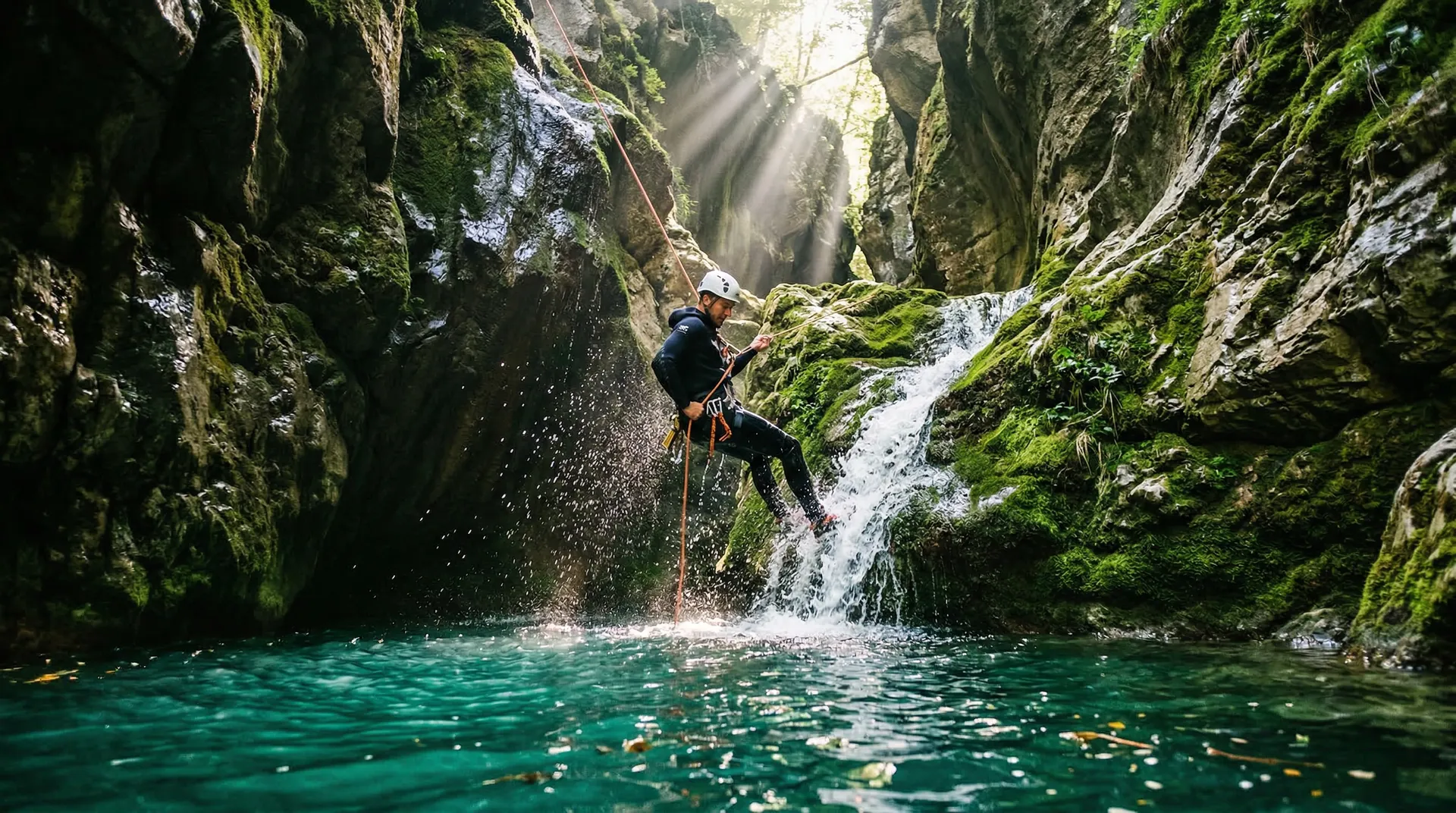
Water at 14 °C, 10 m abseils, natural rock slides polished smooth by centuries of erosion: canyoning combines hiking, swimming and vertical progression through wild gorges. The good news is that most guided outings across Europe require zero prior experience, with prices starting around 40 EUR for a half-day. You don't need climbing skills or elite fitness. What you do need is reliable information before your first descent.
629 offers Canyoning
Compare offersWhat exactly is canyoning?
Canyoning means descending a watercourse carved into a gorge, moving through a mix of wading, swimming, jumping into pools, abseiling and sliding down natural chutes. Unlike rafting (where you stay in a boat) or via ferrata (where you climb a fixed-equipment rock face), here you are in the water, on the rock and sometimes suspended on a rope, all within a few hours.
A beginner outing typically lasts 2.5 to 4 hours, including 30 minutes of approach walk and safety briefing. The descent alternates between calm sections (wading through knee-deep water) and high-intensity moments: a 3 to 8 m jump into a turquoise pool, an abseil alongside a waterfall, a toboggan worn glass-smooth by erosion. On introductory routes, jumps are always optional and abseils are supervised by the guide.
Your first outing: what to expect
It is the unknown that holds most people back, not the actual difficulty. Here is how a typical session unfolds, from car park to post-canyon celebrations.
1. Meeting point and briefing
Arrive at the meeting point (usually a mountain car park) 15 to 30 minutes before departure. The guide hands out gear: neoprene wetsuit, helmet, harness and lanyard. They demonstrate basic techniques (jumping position, abseil control, how to let yourself slide) and lay out the group safety rules. Allow 20 to 30 minutes for this stage.
2. The approach walk
You head to the canyon entry point on foot. Depending on the route, this walk takes 10 to 45 minutes, sometimes along forest trails, sometimes over rocky terrain. The air cools, the sound of water builds, and the canyon opens up ahead.
3. The descent
The main event. You move through sections of wading, swimming across pools, guided abseils and optional jumps. The water is fresh, generally 10 to 18 °C depending on region and season, but the neoprene wetsuit insulates effectively. A beginner route includes an average of 3 to 8 abseils, with heights reaching 5 to 15 m on the more impressive ones.
4. Exit and return
The canyon ends with a return path (15 to 30 minutes of walking) back to the starting point. You hand back the gear and change. Keep a towel and dry clothes in the car.
Total time: 3 to 4 hours, of which 1.5 to 2.5 hours is active descent.
Are you fit enough?
Beginner canyoning is more accessible than it sounds. Introductory routes do not demand any particular athletic background.
Concrete benchmarks: if you can hike for 90 minutes on uneven terrain and swim 25 m unaided, routes graded V1A1 (the easiest level) are well within your reach. The guide adjusts the pace to the group, and technical obstacles are fully supervised.
Age and access: most operators accept participants from age 8 to 12 (depending on the route), with no upper age limit as long as mobility allows. Weight is not as strict a criterion as in skydiving, though wetsuits typically go up to XXL.
Medical contraindications to be aware of: heart conditions, epilepsy, pregnancy and recent joint injuries (knee, ankle, shoulder). If in doubt, inform the guide before the outing. They will adapt the route or point you toward a gentler canyon.
Gear: what is provided, what you bring
On a guided outing (the standard format for a first time), the operator supplies all technical equipment:
- Neoprene wetsuit (3 to 5 mm depending on water temperature)
- Helmet
- Harness with lanyard and descender
- Neoprene socks (varies by operator)
What you need to bring:
- Swimsuit (worn under the wetsuit)
- Closed-toe shoes that can handle water (old trainers, worn hiking boots or aqua shoes)
- Towel and dry clothes for the return
- Water bottle and a snack for afterwards
- Plastic bag to store wet gear
- Sunscreen (the approach walk is often in direct sun)
Some operators rent suitable footwear for 3 to 8 EUR. If you plan to go again, dedicated canyoning shoes start at around 40 EUR.
Understanding difficulty grades
European canyons are graded using a three-letter system: v (verticality), a (aquatic character) and e (engagement, meaning remoteness from rescue). Each letter ranges from 1 (easy) to 7 (extreme).
For a first outing, aim for a route graded V1A1 to V2A2 at most.
| Grade | What you will encounter | Who is it for? |
|---|---|---|
| V1A1 | Short abseils (under 10 m), wading, no mandatory swimming | Families, absolute first-timers |
| V2A2 | Abseils up to 15 m, pool swimming, optional 3 to 5 m jumps | Beginners comfortable in water |
| V3A3 | Abseils over 20 m, sustained current, 8 m+ jumps | Fit participants with prior canyon experience |
Beyond V3A3, you are into sport and technical canyoning. That is not first-outing territory.
Operators offering beginner sessions select V1A1 to V2A2 canyons. If you book an "introduction" or "discovery canyon," the grade will be appropriate.
Where to go beginner canyoning in Europe
France has some of the best canyoning terrain on the continent, with 45 zones listed across major booking platforms. But outstanding beginner spots extend across southern Europe too.
Ardèche: the gentle starting point
Among the warmest canyon water in France (16 to 20 °C in summer), short accessible routes, bright limestone scenery. 20 offers from 34 to 80 EUR, with an average rating of 5/5 across 285 reviews. The Besorgues canyon is a classic for first-timers. Pick this spot if cold water is your main concern.
Gorges du Verdon: the iconic backdrop
Turquoise gorges cut deep into white rock. 11 offers from 45 to 80 EUR, rated 4.99/5 across 311 reviews. Canyoning in the Verdon Gorge delivers some of the most spectacular scenery in the country, with well-established introductory routes.
Annecy: alpine versatility
Between lake and mountain ranges, 16 offers from 50 to 109 EUR. Canyoning near Annecy combines easy canyons (Angon, Montmin) with an alpine setting. A strong choice if you are combining with other outdoor activities in the area.
Aiguilles de Bavella: wild Corsica
The highest-rated canyoning spot in France: 5/5 across 643 reviews. 10 offers from 45 to 80 EUR. Canyoning at Bavella (Pulischellu, Purcaraccia) features crystal-clear pools set in granite towers. Book early in the season as slots fill fast.
Lake Garda, Italy: the international classic
Lake Garda is one of Europe's most popular canyoning destinations outside France. 16 offers from 65 to 130 EUR, with routes suited to beginners running through the limestone gorges north of the lake. Canyoning at Lake Garda makes an excellent option if you are already planning a trip to northern Italy.
Bovec, Slovenia: raw alpine beauty
Tucked into the Julian Alps, Bovec offers 13 canyoning outings from 50 to 105 EUR. Emerald-green water, tight gorges and a growing outdoor scene make canyoning in Bovec a standout for anyone exploring Slovenia or the wider Alps region.
At a glance: Ardèche for warmth and comfort, Verdon for drama, Annecy for versatility, Bavella for intensity, Lake Garda and Bovec for a European road trip.
How much does beginner canyoning cost?
65% of canyoning offers in France fall between 40 and 80 EUR, with a median price of 65 EUR. That is the typical budget for a guided half-day introduction, all technical gear included.
Prices based on listed offers from major operators and booking platforms, March 2026.
What drives the price: duration (half-day vs full day), location (alpine spots tend to run slightly higher), group size (private outing adds 30 to 50%) and timing (July to August means peak rates). Across Italy and Slovenia, expect 50 to 130 EUR for comparable beginner outings.
Total budget to plan for: outing 50 to 70 EUR + shoe rental 5 EUR (optional) + transport. Count on 55 to 80 EUR all-in for a first half-day session. For a full day with packed lunch, budget 80 to 120 EUR.
For a first canyon, a half-day introduction between 45 and 70 EUR is the most common and best-suited format.
When is the best season?
The canyoning season across southern Europe runs from May to October, with peak crowds in July and August. Water temperature ranges from 10 to 20 °C depending on region and month.
| Period | Water temp | Crowds | What to know |
|---|---|---|---|
| May to June | 10 to 15 °C | Low | Early season, quiet canyons, fresh water |
| July to August | 14 to 20 °C | High | Best conditions overall, book 1 to 2 weeks ahead |
| September to October | 12 to 17 °C | Moderate | Pleasant conditions, fewer people, autumn colours |
For a first outing, July or September hit the best balance: comfortable water temperature and available spots.
Frequently asked questions
Do I need to know how to swim?
Yes, basic water confidence is required: you should be able to swim 25 m unaided. On V1A1 routes, swimming sections are short (a few metres) and the neoprene wetsuit helps with buoyancy. The guide handles any technical water passages.
What is the minimum age for canyoning?
Most operators accept children from age 8 on V1A1 routes and from age 12 on V2A2 routes. "Family" sessions are designed for younger participants, with smaller jumps and an adapted pace.
Can I do canyoning if I am afraid of heights?
This is the most common worry, and it is usually manageable. On a beginner route, abseils rarely exceed 10 to 15 m, and you are always secured by a rope. Jumps are optional: if a 5 m drop is too much, the guide offers an alternative (abseil or bypass). Many nervous participants finish the outing and come back for more.
What is the difference between canyoning and rafting?
Rafting takes place in an inflatable boat on a river, in groups of 4 to 8. Canyoning is done on foot, swimming and abseiling through a narrow gorge. Rafting is more of a group ride and less physically demanding. Canyoning is more varied (vertical sections, jumps, slides) and requires more active effort. Budget is comparable: 40 to 80 EUR for a half-day.
See all Canyoning offers
629 offers →