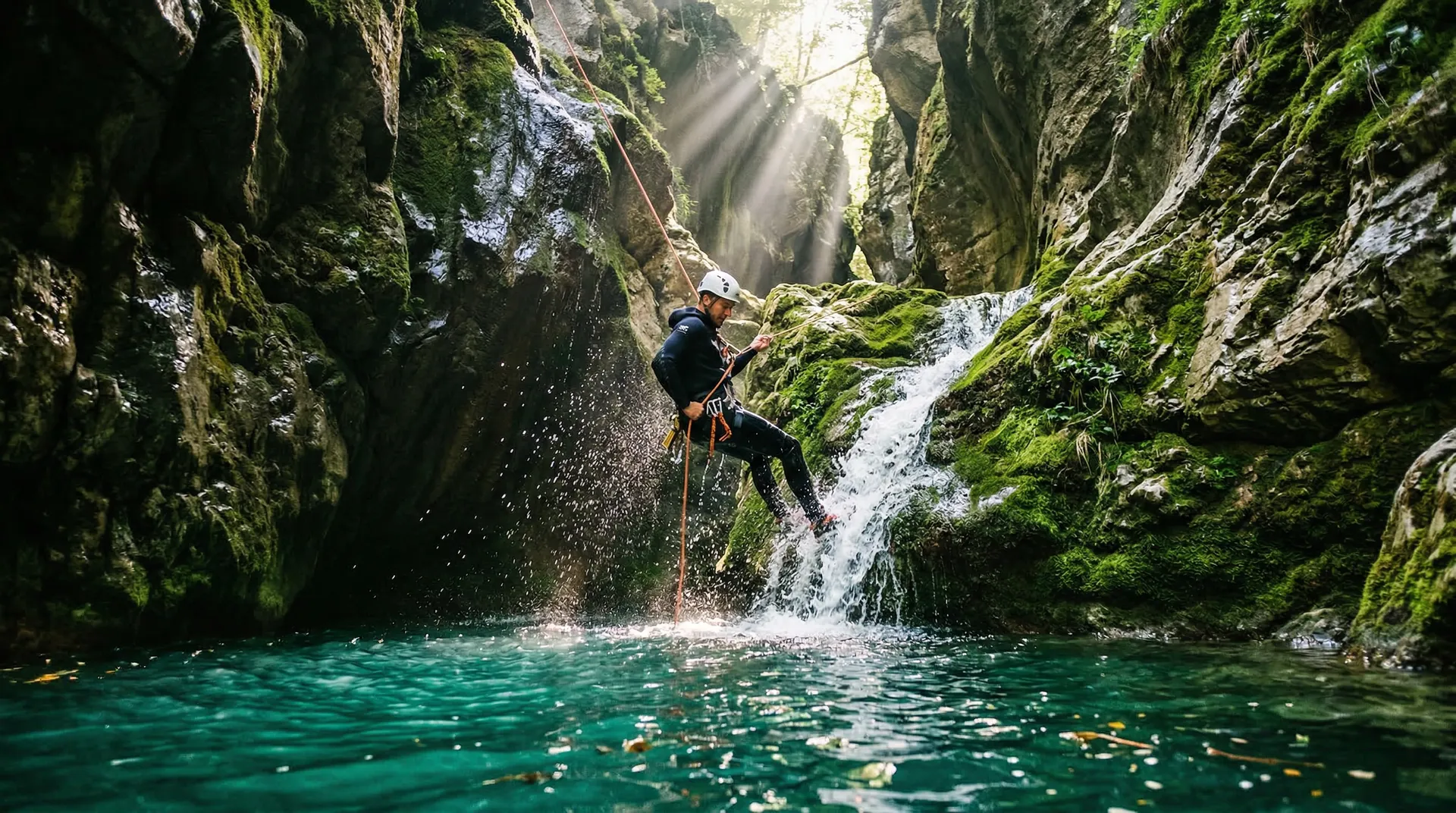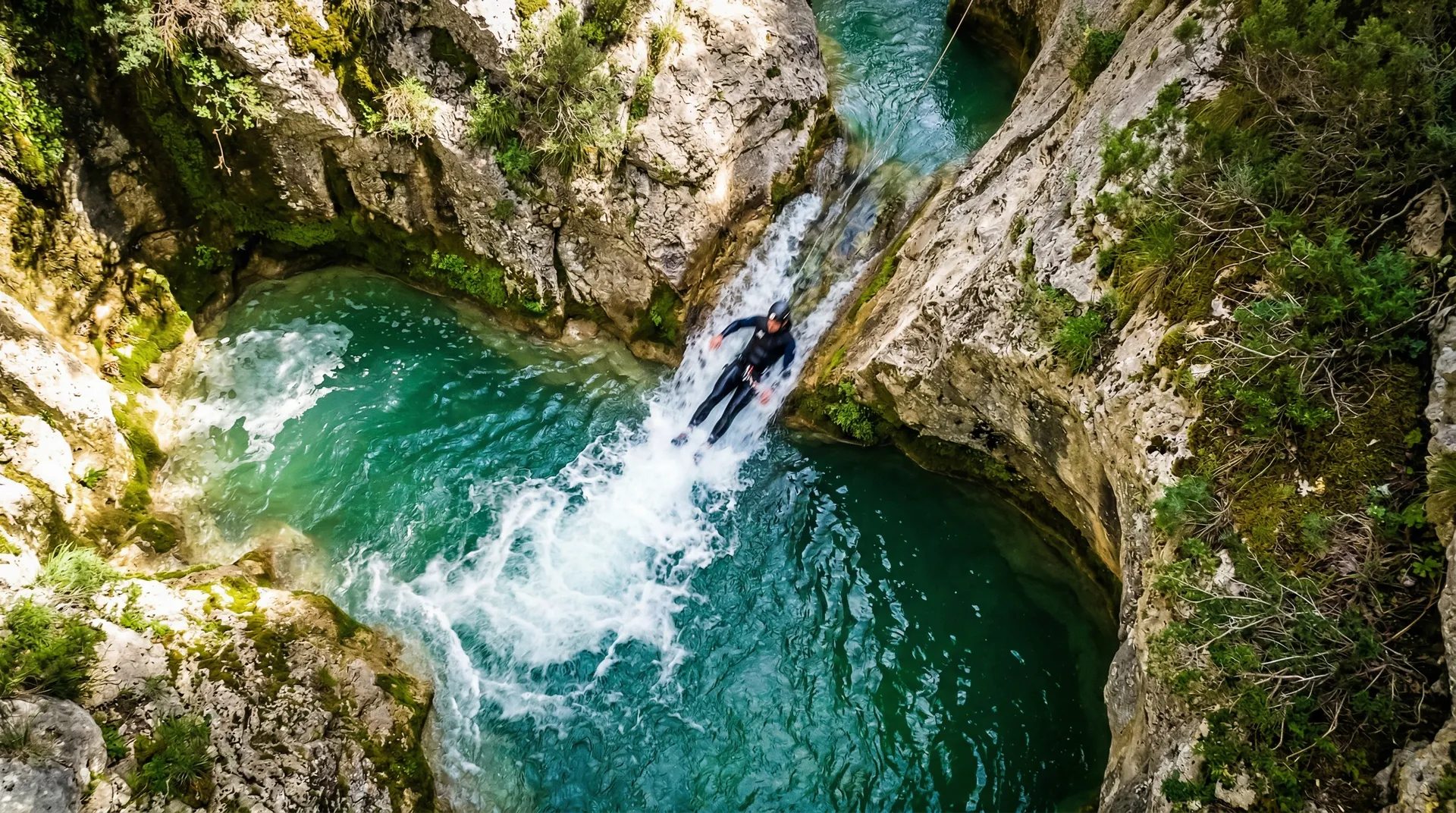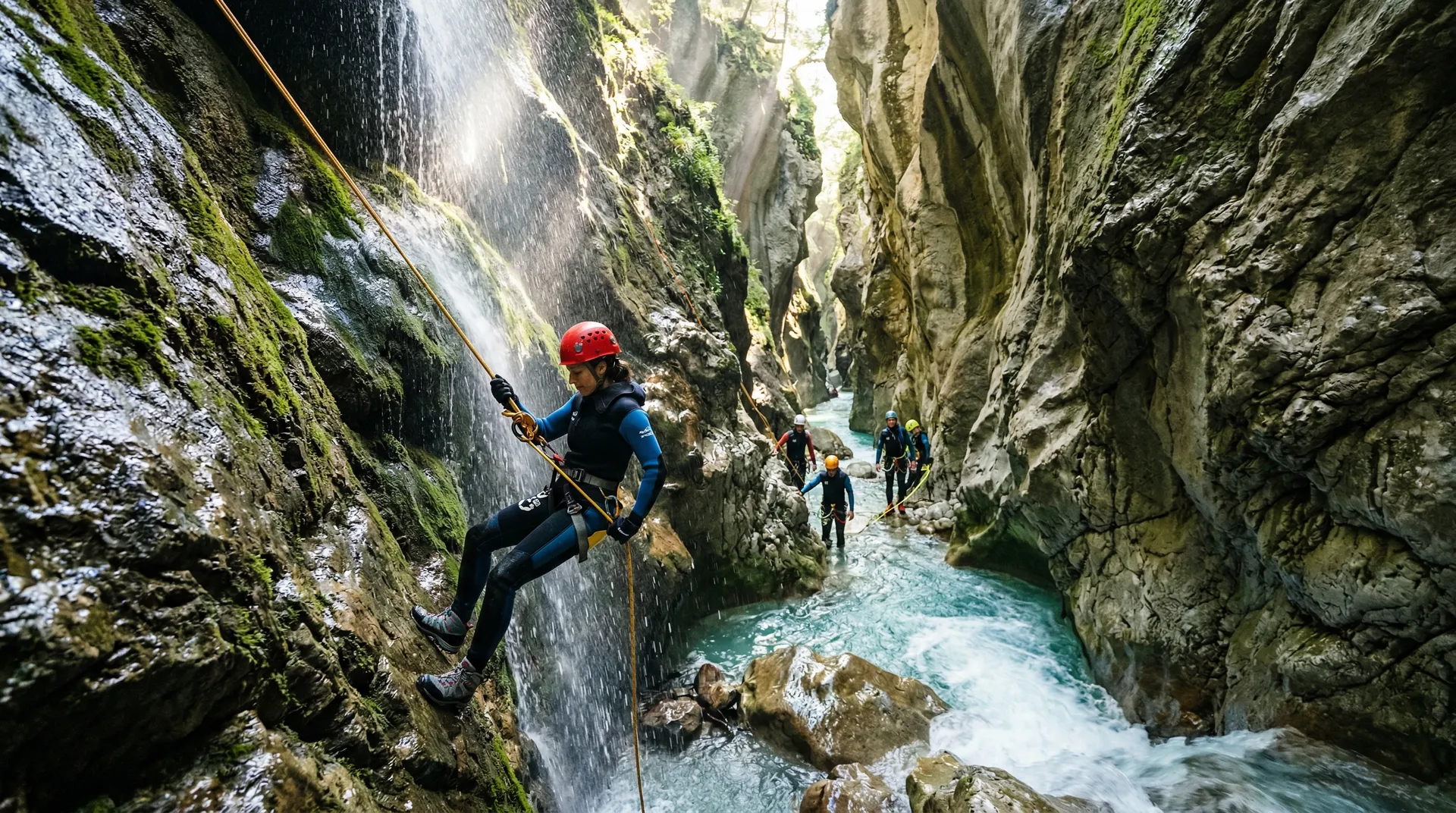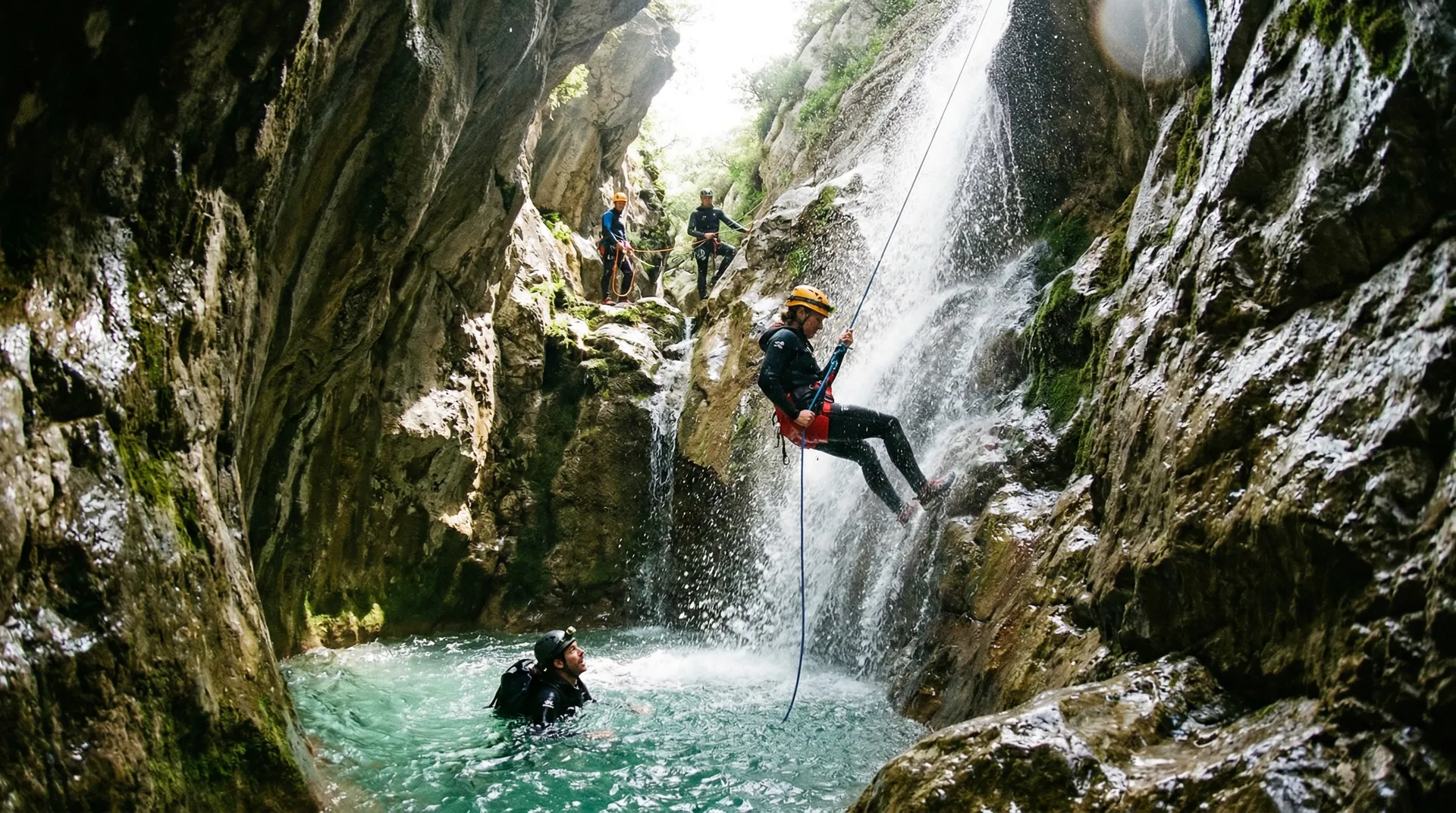
Canyoning is accessible from age 8, as long as you can swim and have a reasonable level of fitness. Most beginner canyons require no prior experience: a 15-minute briefing, a wetsuit provided by the operator, and you're wading through 12 °C water between 10 m abseils. Here are the actual requirements to check before you book.
703 offers Canyoning
Compare offersCanyoning conditions at a glance
| Requirement | Condition | Details |
|---|---|---|
| Minimum age | 8 years (easy routes) | 10-12 for standard routes |
| Weight | 20 kg min, 110-130 kg max | Equipment safety limits |
| Swimming | Able to swim 25 m | Non-negotiable |
| Fitness | Moderate | Able to hike 2-3h on rough terrain |
| Medical certificate | Not required | For guided tours with certified instructors |
| Pregnancy | No | Not recommended at any stage |
These are general conditions. Operators may apply stricter criteria depending on the route difficulty.
Canyoning age limits: minimum and maximum
What's the minimum age?
Children can start from age 8 on beginner-friendly routes: low gradient, simple obstacles, no abseils above 5 m. The child should weigh at least 20 kg for the wetsuit to provide effective insulation.
From age 10 to 12, most standard routes become accessible. Cold tolerance is the limiting factor: canyon water rarely exceeds 15 °C, even in midsummer. For children under 10, outings rarely last more than 2 hours for this reason.
Is there a maximum age?
No official age limit. It comes down to fitness and comfort in water. Routes in destinations like Lake Garda or Bovec offer levels suitable for participants well into their 60s.
Swimming ability: a non-negotiable canyoning requirement
This is the strictest condition. You must be able to swim at least 25 metres in calm water, unaided. Some sections involve crossing deep pools with current, sometimes over 10 to 15 m.
A buoyancy aid is often provided, but it doesn't replace the ability to swim. It stabilises you in current but won't propel you. If you're uncomfortable in water, canyoning isn't the right fit: consider via ferrata instead, which offers comparable intensity without the aquatic element.
Fitness level for canyoning: how fit do you need to be?
You don't need to be an athlete. Beginner canyoning requires the ability to walk 2 to 3 hours on uneven terrain (rocks, boulders, slopes), tolerate cold water (8 to 15 °C depending on the region) and climb up or down 1 to 3 m obstacles with help from a guide.
A good benchmark: if you can manage a 2-hour mountain hike without major difficulty, a V1 or V2 canyon is within reach. More demanding routes (V3 and above) require greater endurance, arm strength for abseils and good cold tolerance over 4 to 6 hours.
Canyoning prices start from around €34 for a discovery route, with most trips costing between €40 and €80 including wetsuit and gear.
Medical contraindications and special cases
Heart and joint conditions
The combination of physical effort and cold water puts strain on the cardiovascular system. Anyone with heart conditions, uncontrolled high blood pressure or severe joint problems (back, knees, shoulders) should consult a doctor first. Severe asthma is also a contraindication.
Pregnancy
Canyoning is not recommended at any stage of pregnancy. Jumps, slides, cold water impacts and prolonged physical effort pose risks incompatible with pregnancy. Almost all operators will refuse participation.
Vertigo
Vertigo isn't necessarily a deal-breaker. On beginner routes (V1), abseils rarely exceed 5 to 8 m, and you descend with your back to the drop, roped in and secured by the guide. The sensation is very different from standing on an exposed ledge. For more technical routes with 15 to 30 m abseils, vertigo can become limiting. Be honest with your guide during the briefing.
Claustrophobia
Some canyons include narrow passages or semi-underground sections. If claustrophobia is a concern, ask about the canyon profile before booking. Routes in Sierra de Guara or Ardèche are generally open, while some Corsican or Pyrenean canyons include enclosed sections. Our canyoning danger guide covers the situations worth knowing about.
Canyoning difficulty levels: choosing the right route
The French grading system rates canyons from V1 (beginner) to V6 (expert), combined with a water rating (A1 to A6). To choose the right route:
| Level | Profile | What it involves |
|---|---|---|
| V1-A1 | Beginner, family | Easy walking, small optional jumps, abseils < 8 m |
| V2-A2 | Sporty beginner | Abseils up to 15 m, pool swimming, 3-4h |
| V3-A3 | Intermediate | 20-30 m abseils, strong current, endurance needed |
| V4+ | Experienced | High physical and technical commitment |
For your first outing, aim for a V1 to V2 route with a certified guide. Our canyoning beginners guide covers what to expect on your first descent.
Frequently asked questions
Can you go canyoning while pregnant?
No. The activity is not recommended at any stage of pregnancy due to jumps, cold water and sustained physical effort. Operators will refuse participation.
Do you need a medical certificate for canyoning?
Not for guided outings with a certified instructor. You'll sign a health disclaimer confirming no major contraindications. If you have any doubts about your fitness, consult a doctor beforehand.
Can you go canyoning if you're afraid of heights?
Yes, on beginner routes (V1-V2). Abseils are short (5 to 8 m) and you descend roped in and secured by the guide. Vertigo is easier to manage while abseiling than when standing on an exposed height. Tell your guide and they'll adapt the pace and offer alternatives to jumps.
What is the minimum age for canyoning?
Children can start from age 8 on specifically adapted routes. They must weigh at least 20 kg and be able to swim. From age 10 to 12, most standard routes are accessible. Minors must be accompanied by an adult and have signed parental consent.
See all Canyoning offers
703 offers →