Is canyoning dangerous? What the data says
Every summer, searches for "canyoning accident" spike after a news story. The data tells a more measured story: over 13 years of records in the Alps, canyoning caused 0.7 deaths per year, compared to 110 for hiking and 20 for rock climbing1. The risk is real, it's quantifiable and it's largely avoidable. Bad jumps, flash floods, poor route choices: here are the actual dangers of canyoning (also called canyoneering in North America) and how to stay safe.
The most comprehensive study on canyoning accidents covers 13 years of data from the Austrian Alps (2005-2018): 471 people involved in 297 incidents, including 9 fatalities1. The mortality rate works out to 0.02 per 1,000 hours of activity.
To put that number in perspective:
| Activity | Deaths/year (Austrian Alps) |
|---|---|
| Hiking | 110 |
| Rock climbing | 20 |
| Canyoning | 0.7 |
Canyoning is roughly 150 times less deadly than mountain hiking. That's not a coincidence: the activity is heavily supervised, equipment is standardised and routes are graded by difficulty.
In France, data from the FFME and SNAPEC confirms this pattern: around 2 to 3 deaths per year out of approximately 120 rescue interventions2. Across the 179 canyoning destinations listed on our site, 94% have an average rating above 4.8/5.
Canyoning is not risk-free. But it's a sport where the danger is identifiable, measurable and reducible through straightforward choices.
The real causes of canyoning accidents
Most accidents don't come down to bad luck. They follow identifiable patterns.
1. Jumping (64% of accidents)
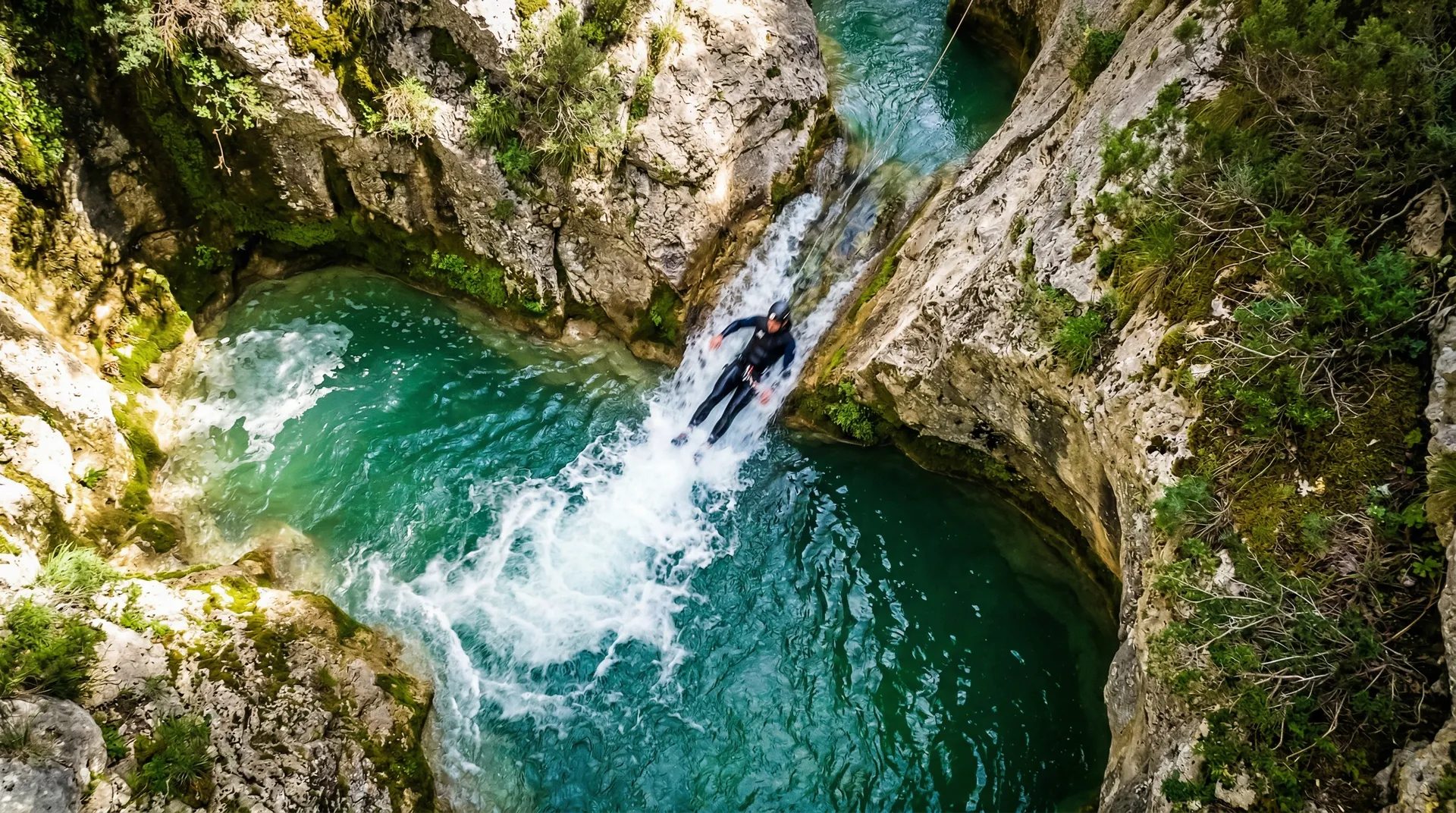
This is the number one factor. Data from the FFME and SNAPEC converges: between 45% and 64% of canyon accidents result from a poorly executed jump2. The impact from an 8-metre jump can generate a force equivalent to 17 times your body weight. Injuries primarily affect the lower limbs (47% of cases) and the spine (15.7%)1.
In the vast majority of guided trips, jumps are optional. A qualified guide always offers an alternative (abseil, bypass). The danger isn't the jump itself, but an uncontrolled jump without proper depth assessment or landing technique.
2. Abseiling (10.8%)
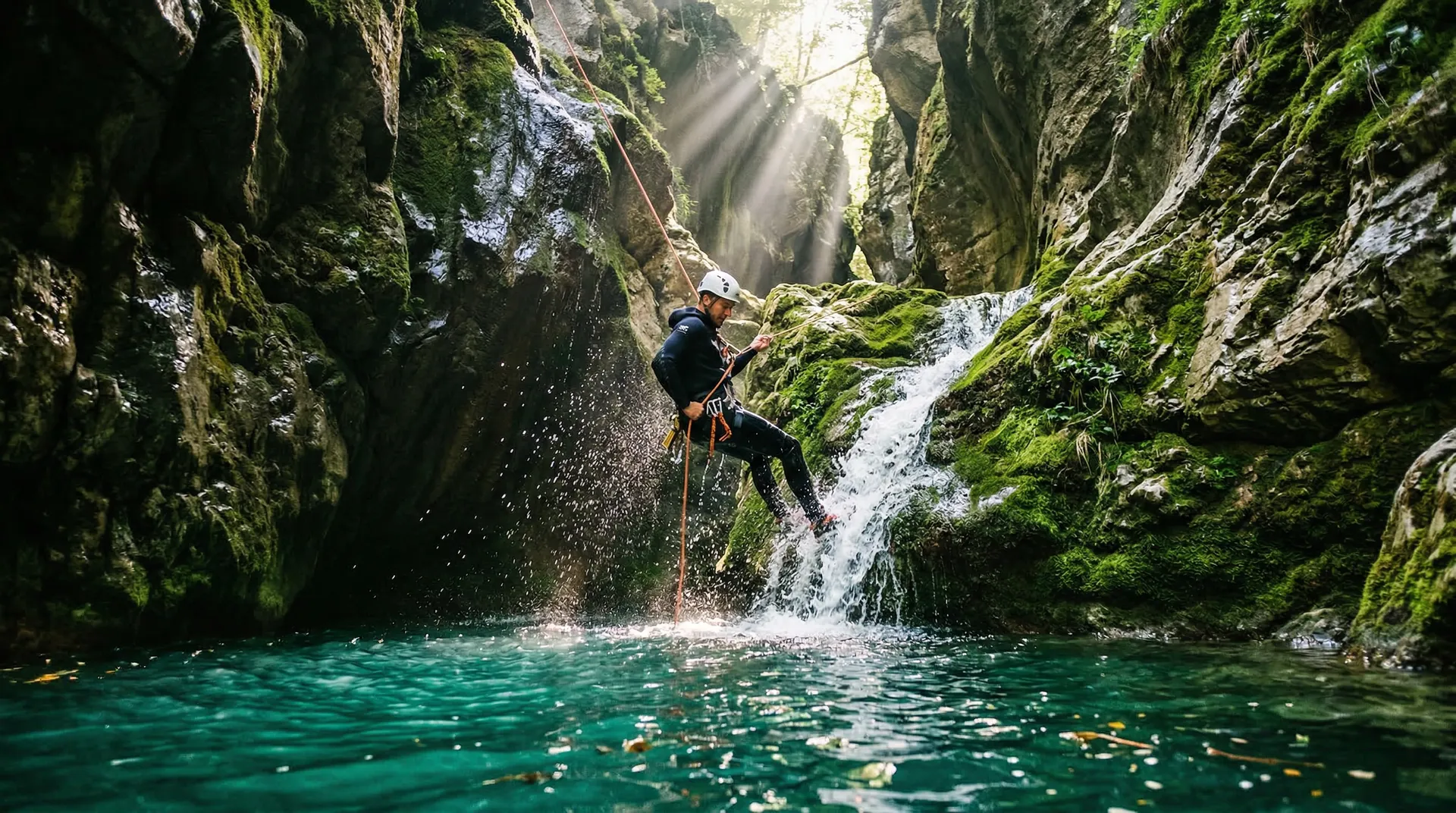
The second most common cause of accidents1. Mistakes with the descender device, hair or clothing caught in the braking system, loss of control on wet rock. On guided trips, the guide checks every anchor and supervises each descent.
3. Slips and falls (8.7%)
Wet boulders, moss, angled slabs. Canyon terrain is slippery by nature. Proper shoes with grippy soles reduce this risk considerably. It's one of the first things a serious operator checks before departure.
4. Flash floods
Statistically rare, but by far the deadliest. Flash floods account for the majority of fatal group accidents in canyons. The flood risk is the only truly unpredictable danger in canyoning, which is why it deserves its own section.
Flash floods: the deadliest danger in canyoning
On 27 July 1999, a sudden flood on the Saxetbach in Switzerland swept away four groups of tourists in a narrow canyon. 21 people lost their lives3. It remains the worst canyoning disaster in history.
On 1 August 2018, in the Zoicu canyon in Corsica, a 3-metre wall of water caused by an upstream storm killed 5 people, including an experienced guide and a 7-year-old child4. The guide had ignored that day's weather alerts.
Both tragedies share the same pattern: a narrow slot canyon, a storm sometimes several kilometres away and water levels rising in minutes.
A flash flood is the one danger in canyoning that has nothing to do with your skill level. Prevention rests on three pillars:
- Check the weather forecast on the morning of the trip, not the day before. Summer storms are localised and fast-forming.
- Respect official closures. In France, certain canyons are closed by prefectural order when hydrological risk is high. Other countries have similar systems.
- Choose a guide who cancels. A good operator postpones a trip rather than taking the risk. That's a sign of professionalism, not an inconvenience.
Guided vs independent canyoning: what a guide changes
In France, commercial canyoning instruction is regulated. Guides must hold a DEJEPS (national-level sports coaching diploma) or equivalent qualification. Group sizes are capped by local regulations.
The Austrian study notes that 64% of accidents occurred during guided trips1. That might sound alarming, but it's explained by a simple bias: the vast majority of participants go with a guide. The accident rate per participant is actually lower on guided trips than on independent ones.
In practical terms, here's what a guide changes:
- Weather and canyon conditions checked on the day
- Equipment inspected and fitted (wetsuit, helmet, harness, descender)
- Each participant's level assessed before departure
- Route choices adapted to the group (bypassing jumps, assisted abseils)
- Knowledge of escape routes if water levels rise
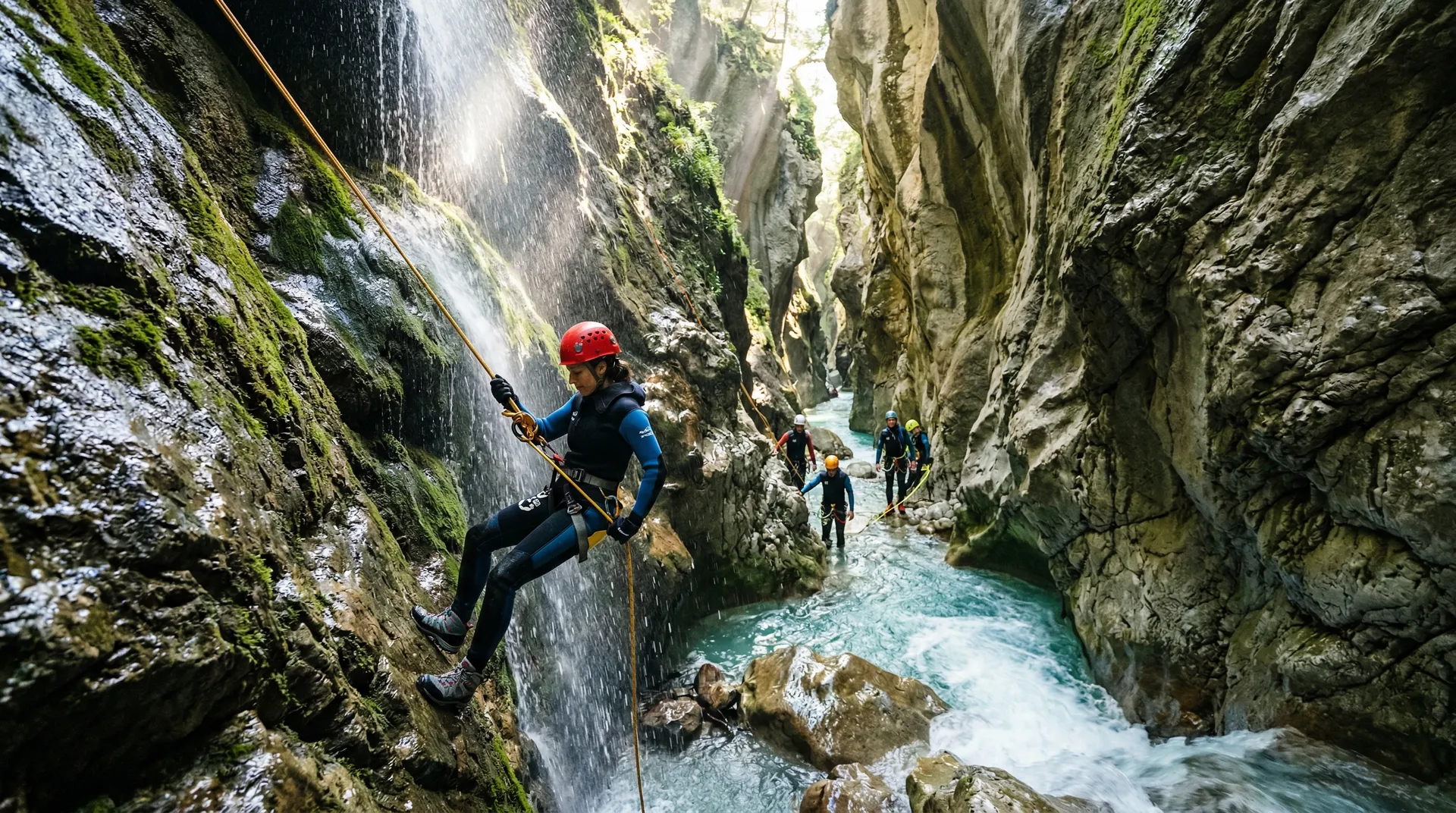
For a first canyoning experience, a qualified guide is the single most important safety factor. It's also the best way to enjoy the canyon instead of worrying about the technical side.
Which canyon for which skill level?
Canyons are graded using a difficulty system: v (vertical, abseils) and a (aquatic, swimming and current), from 1 (easy) to 7 (extreme). A v2a2 canyon is suitable for a guided beginner. A v5a4 requires solid experience.
Across the 629 canyoning offers listed on our site:
| Level | Number of offers | Average price |
|---|---|---|
| Suitable for all | 120 | 67 EUR |
| Occasional sportsperson | 290 | 80 EUR |
| Experienced sportsperson | 139 | 101 EUR |
| Very athletic | 13 | 117 EUR |
Over two thirds of the offers correspond to accessible or intermediate-level routes.
First time, looking to discover. Canyons graded v2a2 or below, with short abseils (8 to 15 m), natural pools and rock slides. Canyoning in Annecy (16 offers, from 50 EUR) or canyoning in Ardèche (20 offers, from 34 EUR) are classic starting points.
Sporty, some experience. v3a3 canyons, abseils of 20 to 40 m, 4 to 6 hours of physical engagement. The Gorges du Verdon (11 offers, 45 to 80 EUR) or Sierra de Guara in Spain offer technical terrain without being extreme.
Expert, high commitment. v5+ canyons with abseils over 60 m, powerful waterfalls, full-day outings. Takamaka in Réunion (207 EUR, 11h, "very athletic") or the full Écouges descent in the Vercors (120 EUR, 7h) are routes where experience and fitness are non-negotiable.
Prices rise with difficulty: +50 to +70% between a "suitable for all" route and a "very athletic" canyon. That makes sense: more technical gear, longer duration, tighter guide-to-participant ratio. For a full breakdown of canyoning prices by level and region, the dedicated guide covers the ranges.
Safety protocol: 6 checks before any canyoning descent
1. Check the weather on the day
Not the day before. Summer storms form in hours. Check local forecasts and any flood/storm warnings from the national weather service.
2. Choose a qualified guide
In France: DEJEPS canyon qualification or FFME federal certification. Verify the operator holds professional liability insurance. All operators listed on BoldTrip Rush work with qualified professionals.
3. Match the route to your level
Don't overestimate your fitness. A "sporty" canyon means 4 to 6 hours of effort in water. For a first outing, the "suitable for all" routes (120 offers, around 67 EUR) are more than enough.
4. Never jump without assessment
Jumps cause 64% of accidents. On a guided trip, the guide checks the depth and landing zone. Going solo, the basic rule applies: if you can't see the bottom, don't jump. Jumping is always optional.
5. Wear full equipment
Neoprene wetsuit (even in summer, canyon water is often between 8 and 14 degrees Celsius), helmet, closed-toe shoes with grippy soles, harness and descender. Equipment is provided by the operator in almost all cases.
6. Leave an itinerary
Tell someone your route and estimated return time. If something goes wrong, rescue teams gain precious time.
Frequently asked questions
Is canyoning dangerous for beginners?
With a qualified guide and a suitable canyon (graded v2a2 or below), the risk is very low. Discovery routes are designed to be progressive, with optional jumps and accessible swimming sections. Most accidents involve people who overestimate their level or jump without proper assessment.
Do you need to know how to swim for canyoning?
You need to be comfortable in water. Some sections include deep pools or stretches of open-water swimming. The neoprene wetsuit provides good buoyancy, but being able to swim 25 metres unaided is a reasonable minimum. Guides assess each participant's water confidence before setting off.
What is the minimum age for canyoning?
Most operators accept children from 8 to 10 years old on discovery routes (accompanied by an adult). Sporty or technical routes are generally reserved for ages 14 and above. There's no upper age limit, but the physical demands need to match the chosen route.
Can you die while canyoning?
Yes, but it's statistically rare. The Austrian study records 9 deaths in 13 years, or 0.7 per year. In France, the average is 2 to 3 deaths per year, mainly linked to flash floods or unsupervised jumps. With a guide, a route matched to your level and verified weather conditions, the risk is comparable to most supervised outdoor sports.
Sources
- 1. Mosimann D. et al., *Canyoning Accidents in the Austrian Alps 2005-2018*, Int. J. Environ. Res. Public Health, 2020.
- 2. FFME / SNAPEC, *Canyoning Accident Census*, data 2020.
- 3. RTS, *20 years on: the Saxetbach canyoning disaster that killed 21*, 2019.
- 4. France 3 Corse, *Zoicu flood: 5 dead in canyoning accident*, 2018.
See all Canyoning offers
703 offers →