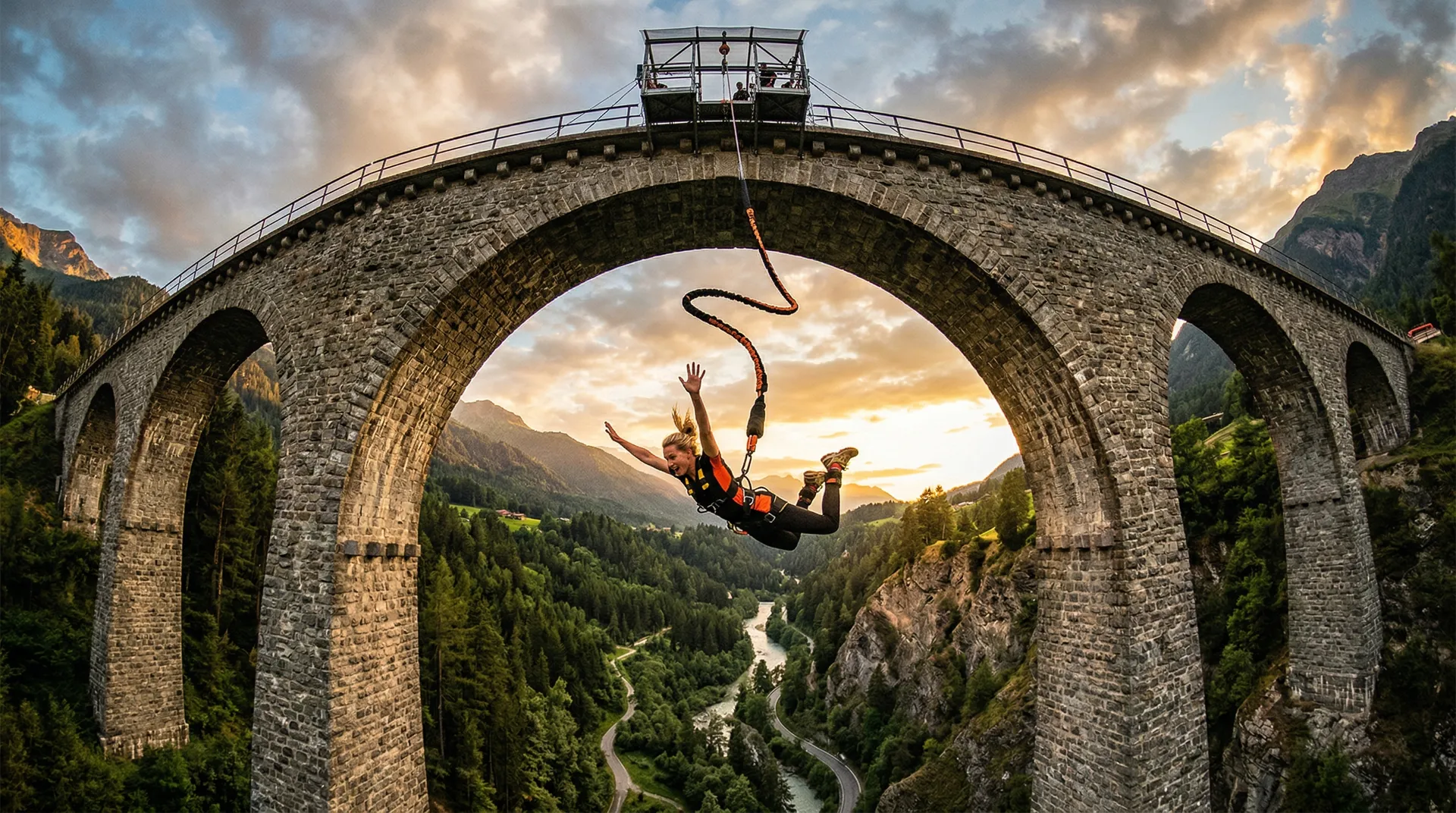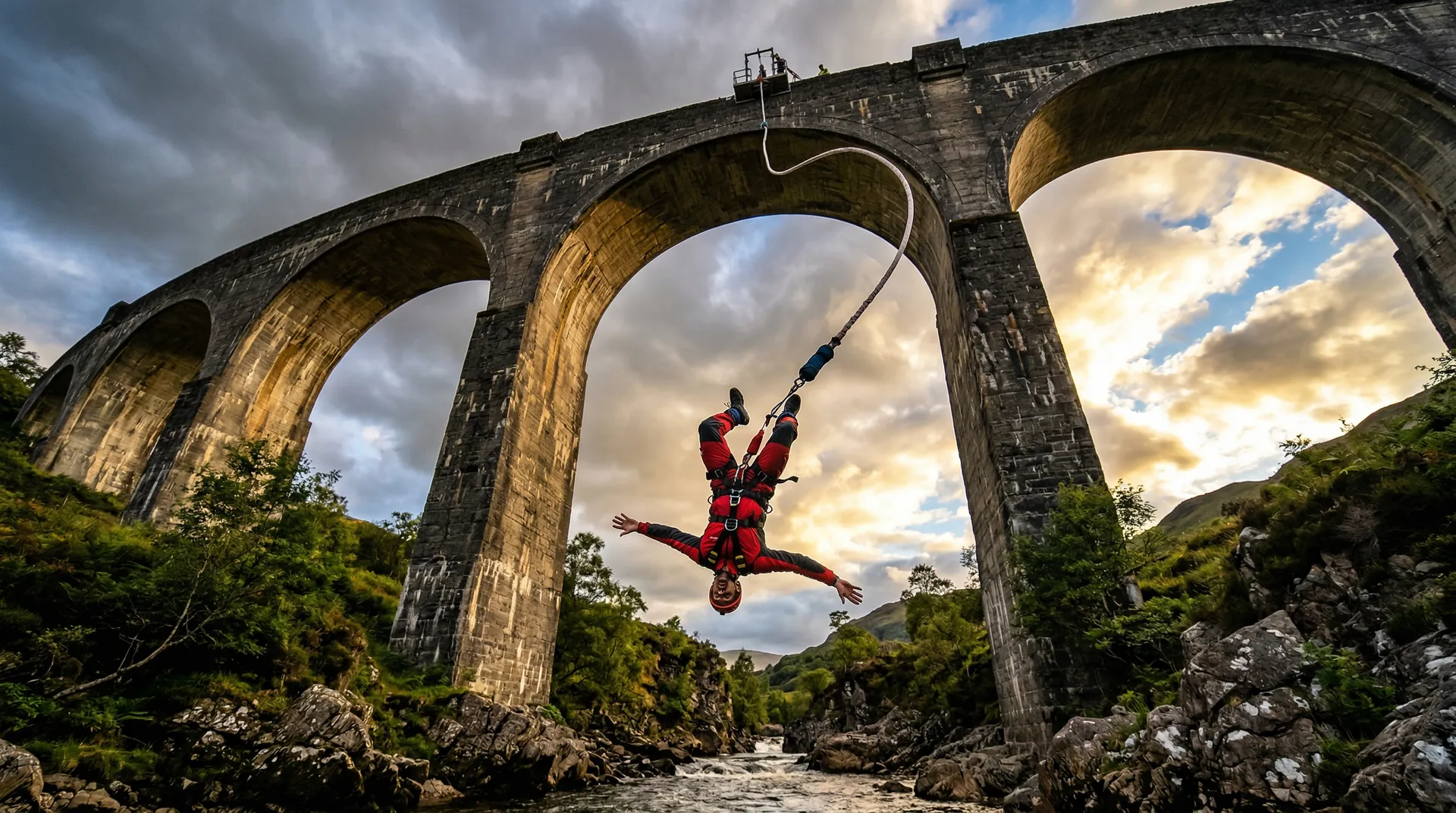
4 seconds of freefall, speeds past 100 km/h, then a 3G rebound that catapults you back towards the sky: your first bungee jump will last under 2 minutes, but you'll remember every fraction. The surprising part? You spend 98% of the time waiting. The other 2% rewire how you think about fear. Here's exactly what happens, what it feels like and how to prepare.
58 offers Bungee Jumping
Compare offersWhat Happens During a First Bungee Jump
The full experience takes 1 to 2 hours on site. The jump itself: under 2 minutes.
1. Arrival and check-in
Arrive 45 minutes to 1 hour before your slot. You fill out a liability waiver and step on the scales: your weight determines which cord will be used. It's the single most important number of the day.
2. Safety briefing
An instructor explains body position, the countdown and what not to do (grabbing the cord, for example). Duration: 5 to 10 minutes. Some sites show a short video.
3. Harnessing
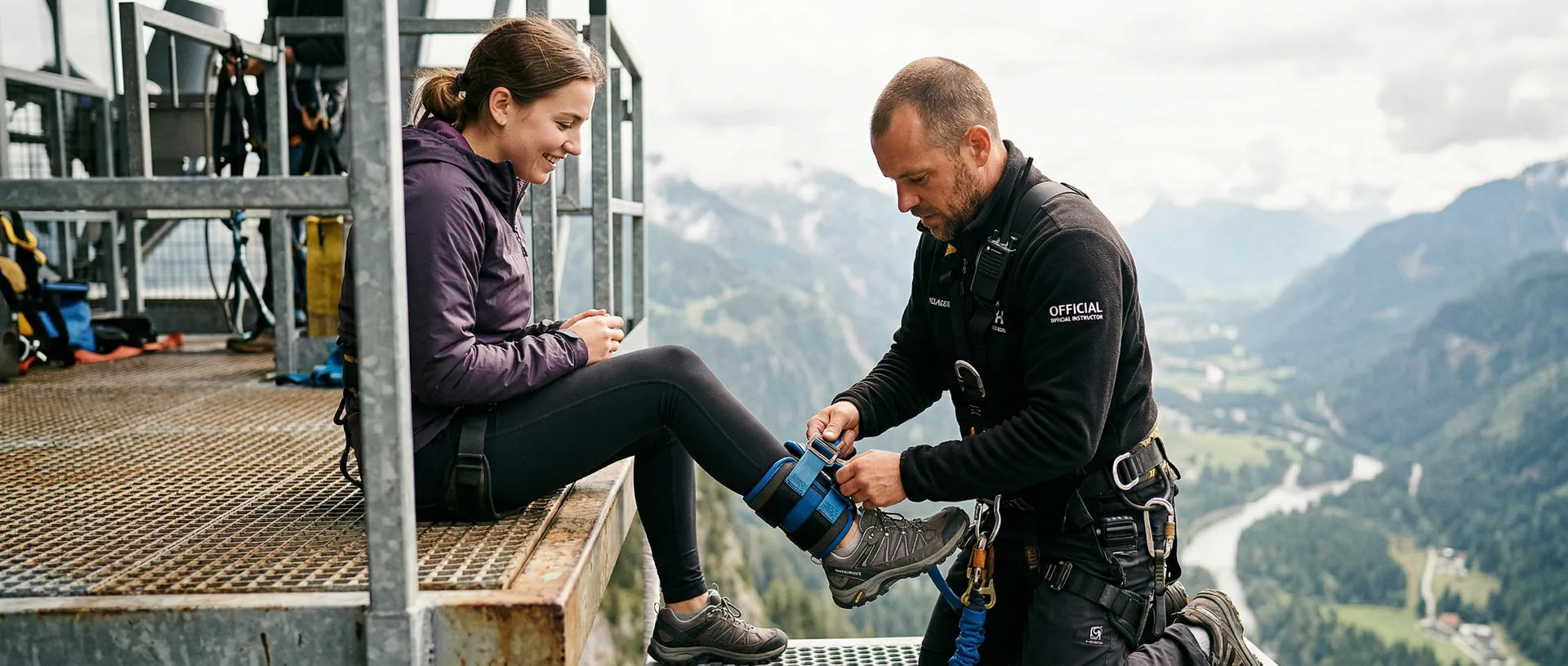
Two systems exist. The ankle harness (the classic setup) sends you headfirst and leaves you hanging upside down. The body harness, attached around the chest, allows more freedom of movement. Most operators use both simultaneously for safety. Allow 5 to 10 minutes.
4. The walk to the platform
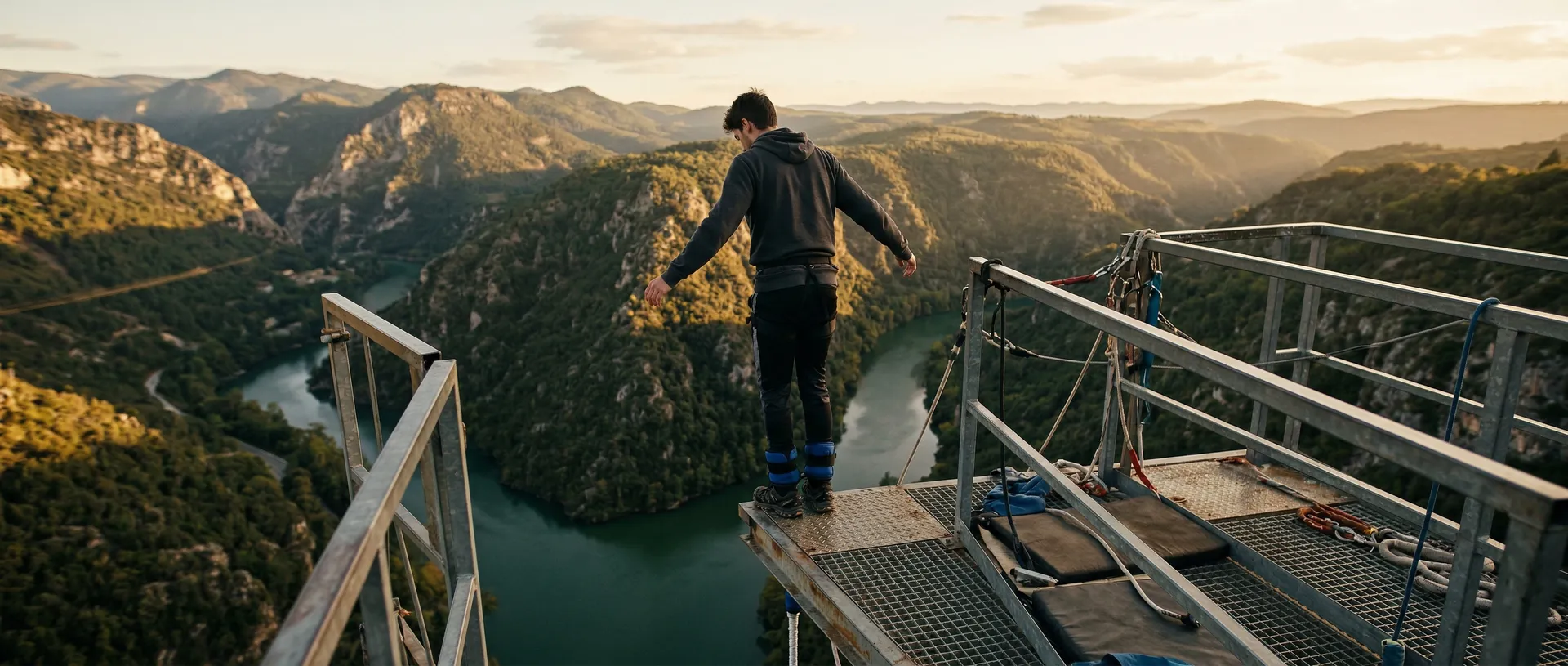
This is often the hardest moment psychologically. Your legs feel weak, your heart rate spikes. At the Gorges du Verdon bungee site, you walk across the Pont de l'Artuby at 182 m above the void. At Kawarau Bridge in New Zealand, the birthplace of commercial bungee, the gorge below is a vivid turquoise.
5. The countdown and the jump
"5, 4, 3, 2, 1... jump!" Every instructor gives the same advice: go on the first countdown. Hesitation makes things exponentially harder. Some first-timers freeze on the edge for 20 minutes, which never helps.
6. Fall, rebounds and recovery
Freefall lasts 2 to 5 seconds depending on height, then the cord engages progressively. 3 to 5 bounces before you stabilise. Recovery is by winch (motorised pull-up, 2 to 5 min) or by boat if the site is above water.
What a Bungee Jump Actually Feels Like
The freefall
Your stomach drops instantly, like a roller coaster, but the sensation lasts longer. Wind roars around your face. From 60-80 m, you hit roughly 100 km/h before the cord starts to work. Your brain takes 1 to 2 seconds to process what's happening. Many jumpers have zero memory of those opening seconds: the prefrontal cortex, overwhelmed, temporarily shuts down.
The rebound
Often the best part. The elastic energy launches you back upwards and, at the peak of the first bounce, you experience total weightlessness for a split second. Peak deceleration reaches 2.5 to 3G (comparable to an intense roller coaster loop). The first bounce takes you back to about 60-70% of the drop height, followed by 3 to 4 more bounces, each shorter.
The immediate aftermath
You hang upside down for 1 to 3 minutes while recovery is prepared. Blood rushes to your head. Your hands shake. Then euphoria rolls in: beta-endorphin levels increase by over 200% in the minutes following a jump1. Uncontrollable laughter, tears, shouts of joy. It's biological, not theatrical.
How to Deal with Fear Before a Bungee Jump
The scariest moment isn't the fall. It's the 10 seconds standing on the edge of the platform.
At AJ Hackett sites worldwide, from Queenstown to Macau, crews guide thousands of first-timers every year. Their number one piece of advice: don't hesitate. The countdown is designed to carry you. If you wait, fear compounds. Every extra second on the edge makes the step harder.
Techniques that work: deep breathing (inhale through the nose, hold for 3 seconds, exhale through the mouth), looking at the horizon rather than the ground and breaking the experience into micro-steps. You're not jumping into a void. You're simply putting one foot in front of the other.
A paradox many jumpers report: jumping from 40-80 m feels scarier than from 200 m. At moderate height, the brain clearly perceives the ground and calculates the distance. At very high altitude, the distance becomes abstract. This is also why bungee jumping is often rated more terrifying than skydiving.
Preparing for Your First Bungee Jump: Practical Tips
What to wear
Fitted, comfortable clothing: tracksuit bottoms, close-fitting t-shirt. Closed-toe shoes are mandatory (trainers). No skirts or loose clothing that would fall over your head once upside down. Remove jewellery, watches and unfixed glasses before harnessing.
What to eat
Light meal 1.5 to 2 hours before the jump: banana, yoghurt, toast. No alcohol (automatic refusal at every site). Don't jump on an empty stomach either (risk of dizziness). The goal: a stomach that's neither empty nor full.
Glasses and video
Regular prescription glasses are not allowed during the jump (they'd fall). Soft contact lenses: accepted by most operators. For video, most sites ban handheld cameras, but some allow a GoPro fixed to a chest harness. The simplest option: buy the operator's photo/video package.
After the Jump: What Nobody Tells You
42% of jumpers report at least one minor symptom in the following hours: slight dizziness, mild neck stiffness or passing headaches2. Some get red eyes (benign subconjunctival haemorrhages from the upside-down position). Everything clears within a few days.
The most notable effect is the adrenaline crash: 1 to 4 hours after the jump, sudden fatigue, mild emotional sensitivity, sometimes difficulty falling asleep. It's your body returning to baseline after an intense stress spike, not a sign of anything wrong.
What everyone also describes: the immediate urge to do it again.
Best Spots for a First Bungee Jump in Europe
For a first jump, aim for 40 to 80 m. The intensity is already at maximum and the price stays reasonable.
| Spot | Country | Height | Price | Profile |
|---|---|---|---|---|
| Lloret de Mar | Spain | 50-70 m | 40-70 EUR | Cheapest in Europe, festival atmosphere |
| Killiecrankie (Highland Fling) | UK | 40 m | 50 GBP | Scotland's iconic bridge jump |
| London (O2 Arena crane) | UK | 50 m | 75 GBP | Urban jump, no travel needed |
| Viaduc de la Souleuvre | France | 61 m | 69-99 EUR | Historic AJ Hackett site, Normandy |
| Luz-Saint-Sauveur (Pont Napoleon) | France | 65 m | 80 EUR | Mountain setting, France's most popular |
| Murillo de Gallego | Spain | 25 m | 40 EUR | Ultra-accessible, ideal for discovery |
Prices range from 40 EUR in Spain to 75 GBP in London: the bungee jumping cost guide breaks down every destination. For eligibility, the weight and age conditions are accessible to most profiles.
Frequently asked questions
Does bungee jumping hurt?
No. The fall itself is painless. The harness can put pressure on your ankles or torso, but it isn't painful. The only possible discomforts are mild neck stiffness and passing dizziness in the hours afterwards.
Can you bungee jump if you're scared of heights?
Yes. Fear of heights is not a medical contra-indication. Most first-time jumpers feel apprehension on the platform. The only problematic vertigo comes from inner ear conditions. More details in our bungee jumping danger guide.
Do you have to jump headfirst?
That's the standard method with an ankle harness: you dive forward, arms open, like a swan dive. It gives the best sensation of flight. Some sites also offer a body harness for feet-first jumps, but the intensity is generally lower.
How long does a bungee jump last?
The freefall lasts 2 to 5 seconds depending on height. The bounces take 30 to 90 seconds. Recovery (winch or boat) adds 2 to 10 minutes. In total, expect 1 to 2 hours on site, with less than 2 minutes in the air.
Can you film your bungee jump?
Most operators ban handheld cameras (projectile risk). Some allow a GoPro fixed to a harness. The easiest option: buy the operator's photo/video package, filmed from the platform and the ground.
What's the best time of day to bungee jump?
Early morning. Fewer crowds, calmer winds, pleasant temperatures. Psychologically, the shorter wait time helps too.
Sources
- Hennig J. et al., Changes in cortisol and beta-endorphin after bungee jumping, Neuropsychobiology, 1994.
- Hite P.R. et al., Symptoms in recreational bungee jumpers, Journal of Sports Science & Medicine, 2009.
See all Bungee Jumping offers
58 offers →