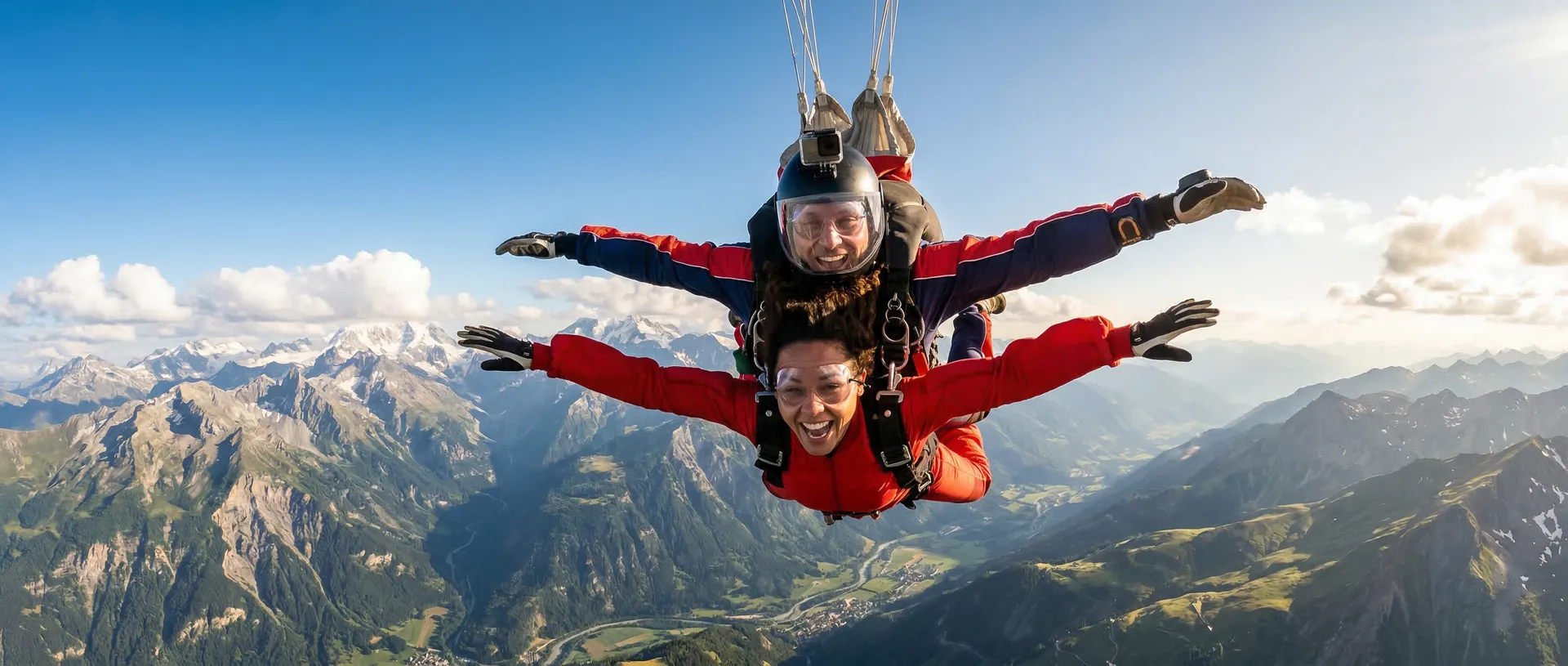
In tandem skydiving, the fatality rate sits at roughly 1 in 500,000 jumps. That is lower than many everyday activities, including driving to the airfield. A systematic medical review covering 62 million jumps across six countries found an injury rate of 0.044% and a fatality rate of 0.0011%1. The numbers paint a very different picture from what most first-timers imagine.
48 offers Skydiving
Compare offersSkydiving accident statistics: the real data
The most comprehensive data comes from the United States Parachute Association (USPA), which tracks every reported fatality among its members.
| Country | Jumps/year | Fatalities/year | Fatality rate |
|---|---|---|---|
| United States | 3.47 million (2025) | 16 | 0.00046% |
| France | ~500,000 | ~3 | 0.0006% |
| Germany | ~240,000 | ~1 | 0.0004% |
In 2024, the US recorded its lowest fatality rate ever: 0.23 per 100,000 jumps, just 9 deaths out of 3.9 million jumps2. The 2025 figure rose slightly to 0.46 per 100,000 but remains near historic lows.
The systematic review published in PLOS ONE (2023) compiled data from six countries across 62 million jumps. The result: 0.044% injury rate and 0.0011% fatality rate1. Roughly 1 serious injury per 2,300 jumps and 1 death per 91,000 jumps across all disciplines (solo and tandem combined).
Tandem vs solo: two very different risk levels
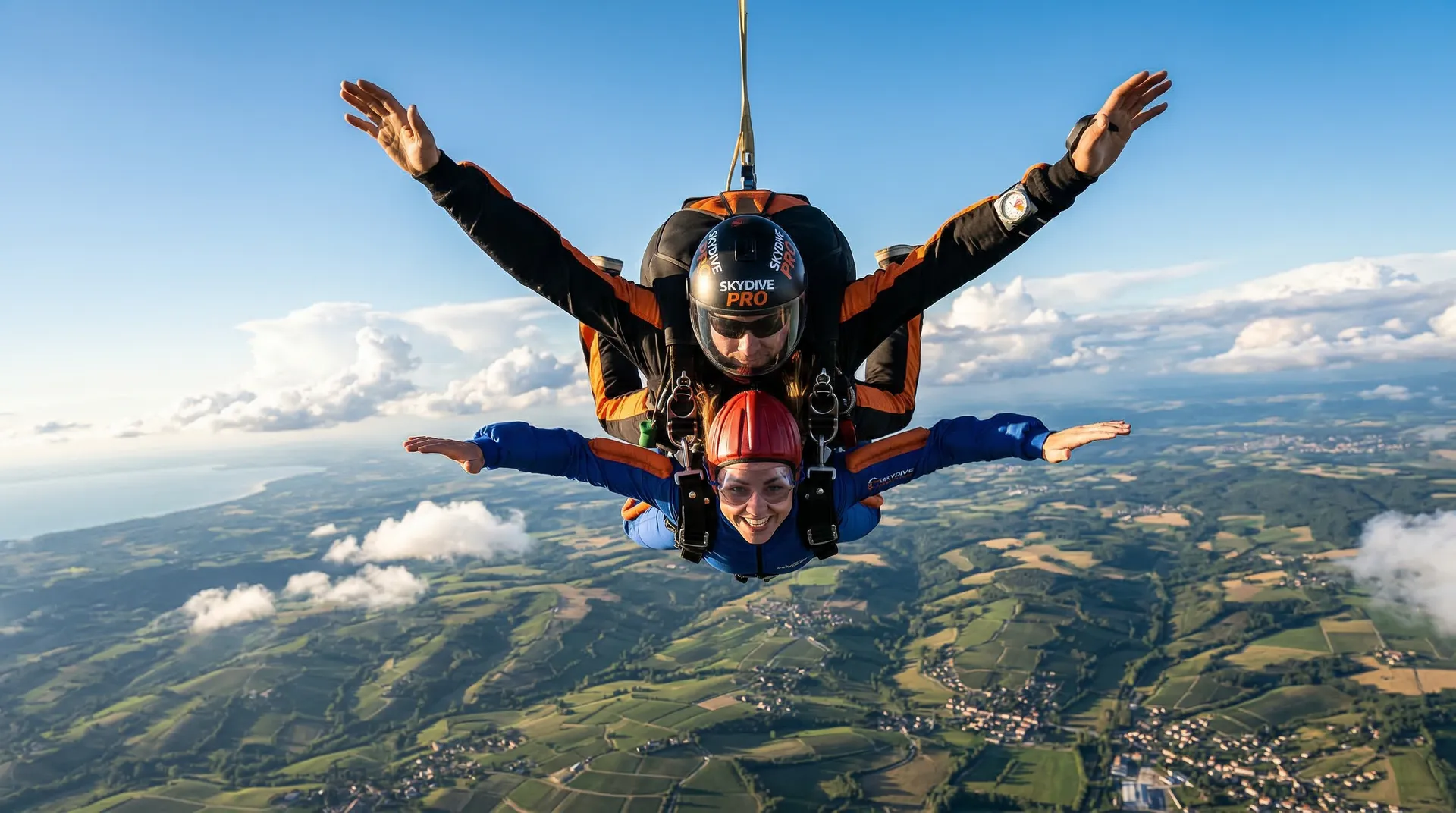
This is the single most important distinction. A tandem jump, where you are harnessed to a certified instructor who handles every technical phase, carries a fundamentally lower risk than solo skydiving.
Tandem: near-zero risk
The USPA estimates the tandem fatality rate at approximately 1 per 500,000 jumps over the past decade2. In France, the national federation (FFP) has recorded zero tandem fatalities since 1988, spanning over 35 years and millions of jumps.
The tandem master typically has 1,000+ jumps of experience. They manage the freefall, canopy deployment, navigation and landing. You make no technical decisions.
Solo: the human factor
The vast majority of skydiving fatalities involve experienced solo jumpers. Main causes: misjudged landings, poor canopy management or slow decision-making during malfunctions. Equipment failure is extremely rare. Almost every fatal accident traces back to a human decision.
Where do accidents happen?
1. Landing
88% of injuries occur during the landing phase1. Lower extremities and the lumbar spine account for 47-59% of all injuries. Most are sprains or fractures from hard landings, not equipment failures.
2. Human error in freefall
Wrong canopy choice, late low turns, mid-air collisions: critical scenarios almost always involve a human decision. Highly experienced jumpers practising high-performance disciplines (swooping, wingsuit proximity) account for a disproportionate share of fatalities.
3. Weather
Shifting ground winds, thermal turbulence, unexpected gusts. Reputable centres cancel without hesitation when conditions deteriorate. A centre that pushes through strong winds is a red flag, not a sign of confidence.
4. Equipment (the least dangerous factor)
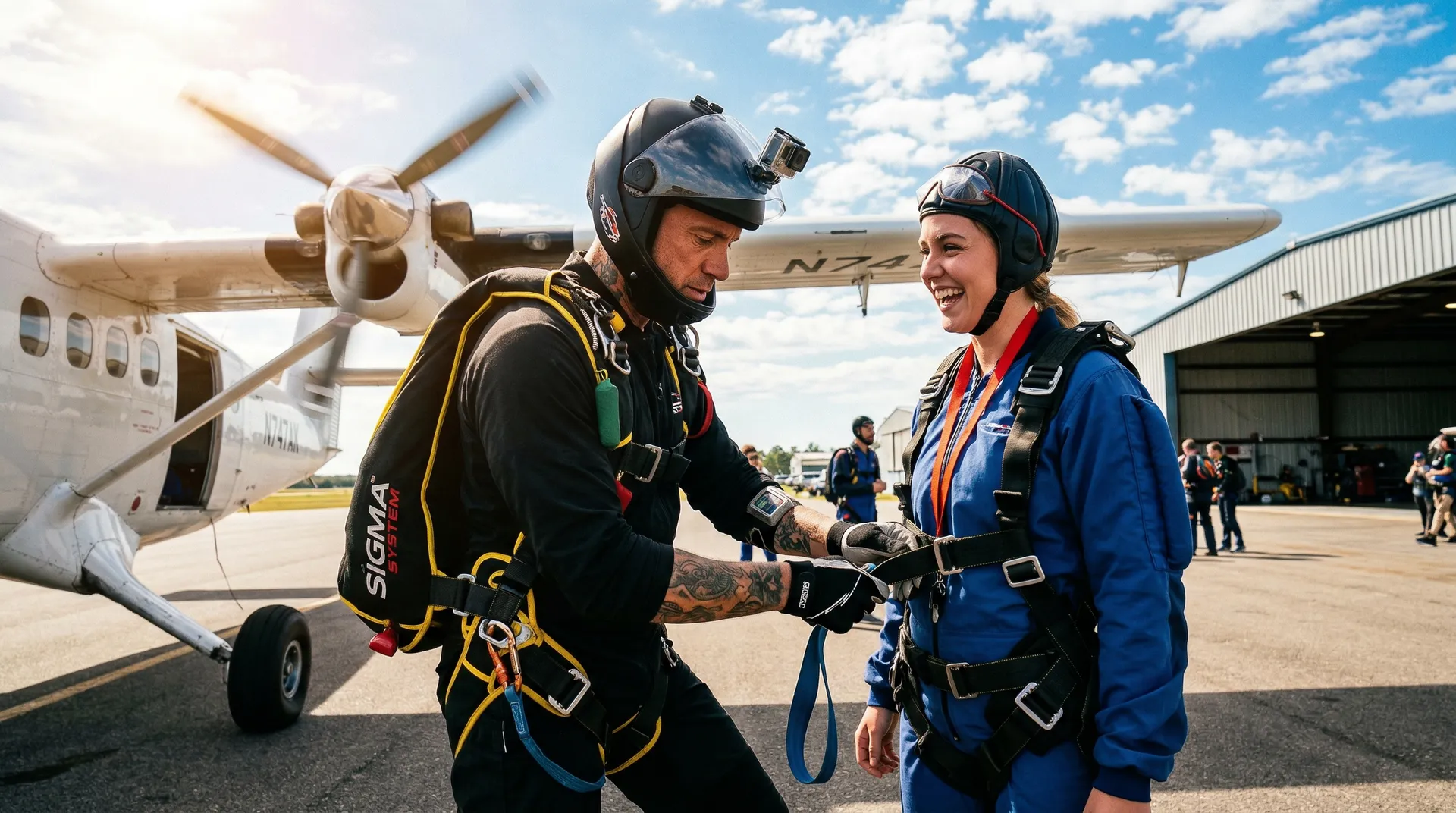
Modern rigs include an Automatic Activation Device (AAD, typically a Cypres). If the jumper fails to deploy at a set altitude, the AAD fires the reserve automatically. Every rig also carries an independent reserve canopy. The USPA reserve deployment rate is about 1 per 726 jumps2. The vast majority of reserve rides end without injury.
Skydiving compared to other activities
The numbers gain real meaning in context.
| Activity | Deaths per 100,000 participations |
|---|---|
| Driving | 12.4 |
| Horse riding | ~1.5 |
| BASE jumping | ~20 (43x skydiving) |
| Skydiving (all) | 0.46 |
| Tandem skydiving | ~0.2 |
BASE jumping, often confused with skydiving, is a radically different discipline: low altitude, zero margin for error, no reserve parachute. Comparing it to a tandem skydive is meaningless.
Statistically, your drive to the airfield carries a higher risk than the jump itself.
How safety has evolved
In 1961, the USPA recorded 11.12 fatalities per 100,000 jumps. In 2025: 0.46. The fatality rate has been divided by 24 in sixty years2.
Three factors combined to drive this improvement: equipment (ram-air canopies, AADs, modern reserves), training (progressive licence systems, federation oversight) and regulation (mandatory gear inspections, instructor certifications).
The trend has not reversed. Each decade brings further risk reduction.
Jumping with confidence: what actually matters
Residual risk exists, as with any sport. But in tandem, it is objectively very low. Before booking, check these four things:
- The centre is affiliated with the national federation (BPA in the UK, USPA in the US, FFP in France)
- The tandem master has 500+ jumps minimum (in France, the legal minimum for tandem certification is 1,000)
- Equipment is inspected daily and fitted with an AAD
- The centre cancels in adverse weather without pressure to jump regardless
If those boxes are ticked, the data speaks for itself. 1 risk in 500,000 tandem jumps. A tandem skydive costs between 180 and 760 euros across Europe and the requirements to jump are accessible to most people. After that, it is 200 km/h of freefall and nothing but sky.
Frequently asked questions
Can a parachute fail to open?
Yes, a main canopy can malfunction. That is why every rig carries an independent reserve parachute and an Automatic Activation Device (AAD). The reserve deployment rate among USPA members is about 1 per 726 jumps. The vast majority of reserve rides end without injury. A scenario where both canopies fail simultaneously is extraordinarily rare.
Is tandem skydiving dangerous?
It is the safest form of skydiving. Approximately 1 fatality per 500,000 tandem jumps over the past decade (USPA data). In France, zero tandem fatalities have been recorded since 1988. You are attached to an instructor with 1,000+ jumps who handles every technical phase.
What medical conditions prevent you from skydiving?
Main contraindications are severe heart conditions, uncontrolled epilepsy, serious back problems and pregnancy. Most centres set a weight limit between 90 and 100 kg. Minimum age is typically 16 in the UK (18 for solo). A standard medical certificate is sufficient if you have any doubts.
What is the most dangerous extreme sport?
BASE jumping, at roughly 20 deaths per 100,000 jumps, is about 43 times more dangerous than conventional skydiving. High-altitude mountaineering (above 8,000 m) also carries significantly higher mortality rates. Tandem skydiving, at roughly 0.2 per 100,000, ranks among the lowest-risk thrill activities.
Sources
- Westman A. et al., Parachuting-related injuries and fatalities: a systematic review, PLOS ONE, 2023 (PMC9859333).
- United States Parachute Association (USPA), Skydiving Safety, 2024-2025 data.
See all Skydiving offers
48 offers →