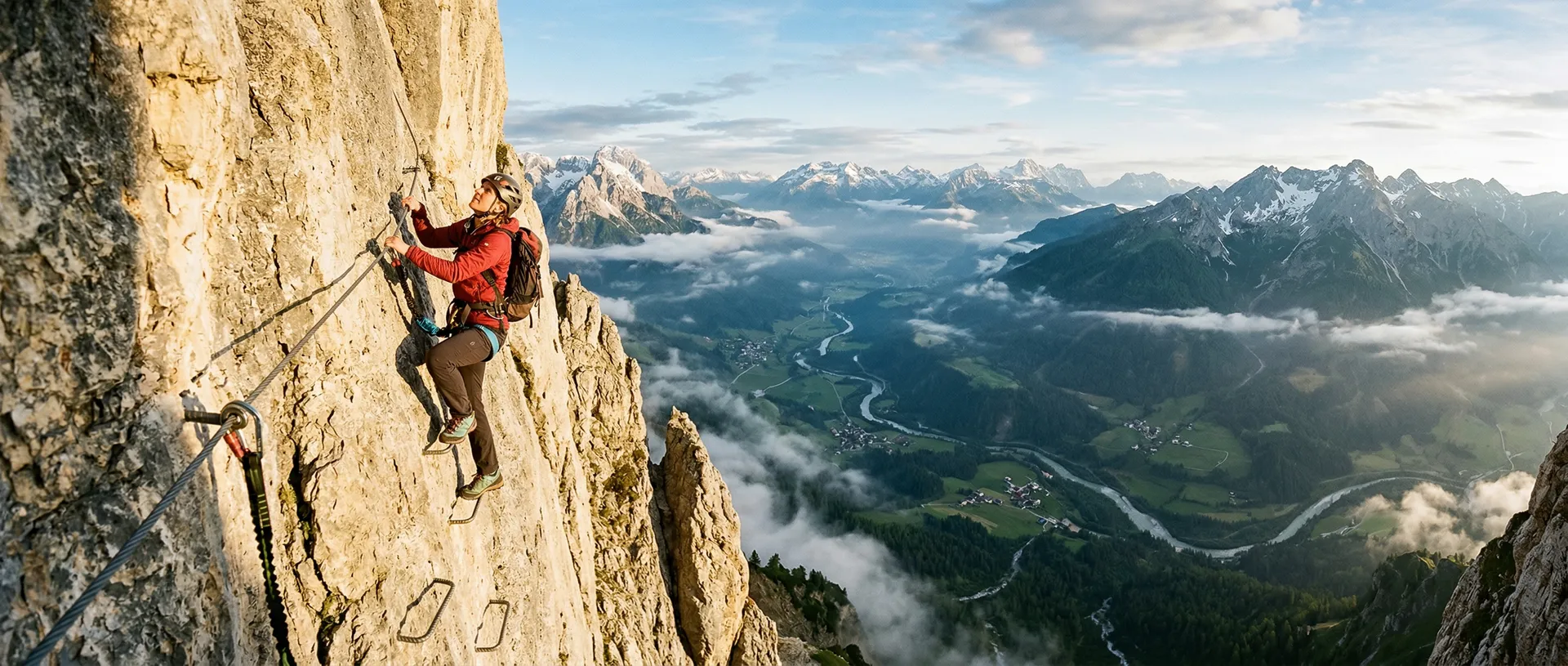
A beginner via ferrata takes 2.5 to 5 hours, costs €37 to €100 with a certified guide and requires zero climbing experience. You move along steel rungs bolted into the rock face, clipped to a continuous safety cable, with an instructor managing safety and pace. The real challenge isn't technique: it's choosing the right route and knowing what to expect.
231 offers Via Ferrata
Compare offersWhat is a via ferrata?
A rocky route equipped with metal rungs, cables, ladders and sometimes suspension bridges or zip lines. You're connected at all times to a safety cable via a lanyard system with an energy absorber. You progress with your feet on the rungs and your hands on the cable or rock.
Unlike rock climbing, via ferrata doesn't require climbing technique: the holds are already there, fixed into the wall. That's what makes it accessible to a wide audience, including children from age 8-10 depending on the route. Guided outings typically last half a day (2.5 to 4 hours), with the longest routes reaching 5 to 6 hours.
Via ferrata difficulty levels: choosing the right route
The French grading system uses letters from F (easy) to ED (extremely difficult). The international system runs from K1 to K6. For a first outing, aim for F or K1-K2.
| French grade | K grade | Profile | What it involves |
|---|---|---|---|
| F (easy) | K1 | Beginner, family | Spaced rungs, low verticality, no exposed sections |
| PD (moderate) | K2 | Sporty beginner | Some vertical sections, possible suspension bridges |
| AD (fairly hard) | K3 | Intermediate | Sustained verticality, arms engaged, 2-4h |
| D (hard) | K4 | Experienced | Overhanging sections, strength and endurance required |
| TD / ED | K5-K6 | Expert | For experienced climbers only |
For your first outing, an F or PD route with a guide is the right call. You'll learn the essential moves (clipping carabiners at anchor points, foot placement, pace management) without excessive physical strain. Our via ferrata danger guide puts the real risks in perspective by difficulty level.
Before the day: preparing for your first via ferrata
Book a guide
For a first outing, a certified mountain guide is the best investment. They handle equipment, safety, pacing and teach you the basics. Via ferrata prices range from €37 to €100 depending on duration and destination. Going independently, budget €15 to €20 per day for gear rental.
Check the weather
Never attempt a via ferrata in a thunderstorm: the steel cables conduct lightning. Also check for rain: wet rock and metal rungs become slippery. Check mountain weather on the morning of your outing.
Prepare physically and pack right
No specific training needed. Bring at least 1 litre of water per person (1.5 l in hot weather), an energy bar and a light backpack. Eat normally before the outing. Fatigue in via ferrata comes from your arms first: if you can hold a pull-up bar for 30 seconds, you're more than ready for a K1-K2.
What happens on a via ferrata: step by step
1. Welcome and briefing (15-20 min)
Meet at the starting point, usually a mountain car park. The guide checks footwear (grippy soles required, no smooth trainers), distributes gear and explains the two-carabiner lanyard system. The golden rule: one carabiner always clipped to the cable, even at anchor points.
2. Gearing up and approach walk (15-30 min)
Put on harness, helmet and lanyard. The guide runs a buddy check (each participant checks their neighbour's gear). The approach walk to the base of the wall typically takes 10 to 30 minutes depending on the site.
3. Climbing the route (1.5 to 3 hours)
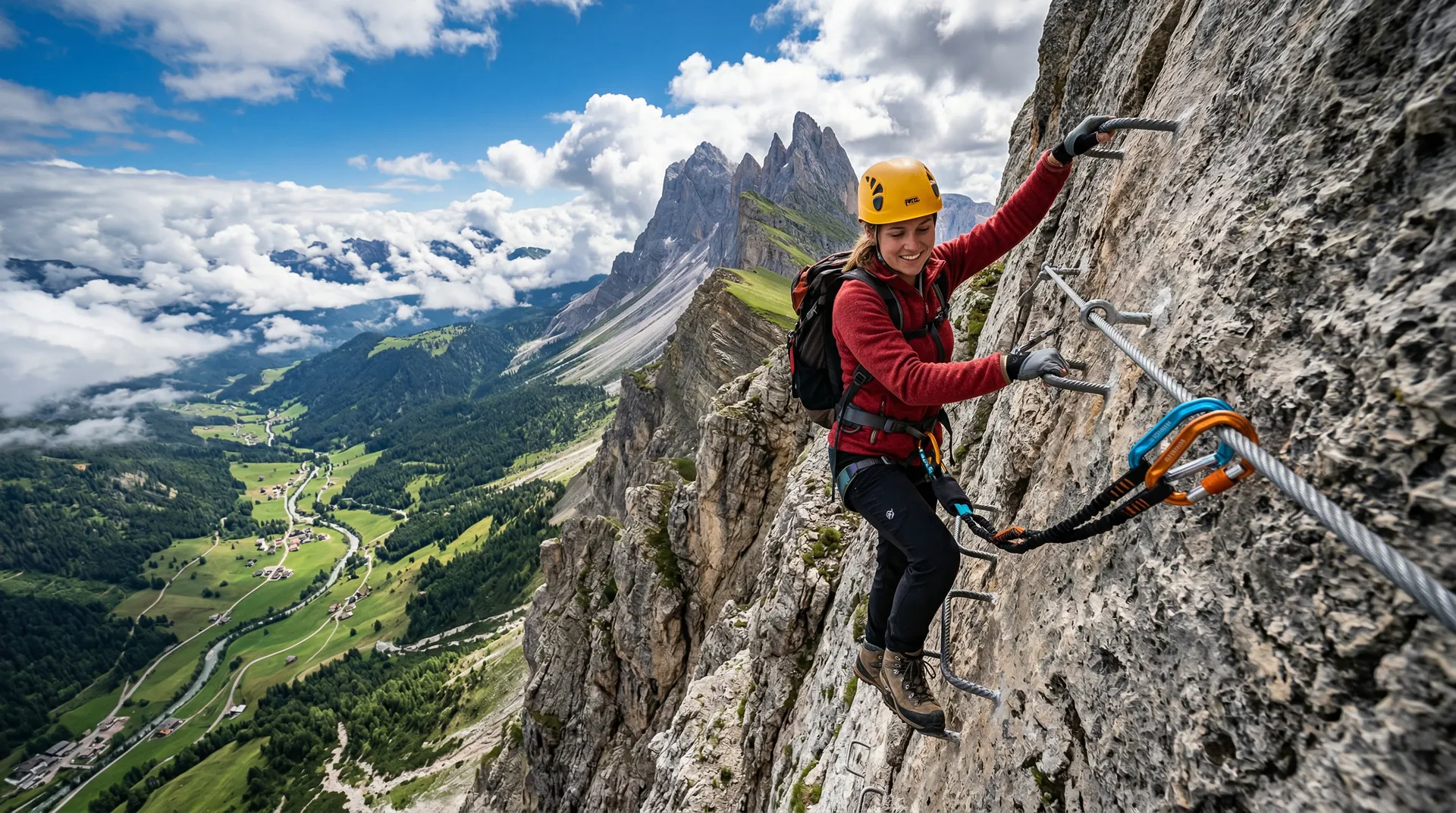
Feet on the rungs, hands on the cable or rock. At each anchor point (where the cable is fixed to the rock), you unclip one carabiner, pass it to the other side, then do the same with the second. The guide shows you the move the first time: after 3 or 4 anchor points, it's automatic.
The key technique: push with your legs, arms straight. Pulling with your arms tires you three times faster. Keep your body close to the wall and look where to place your feet rather than down.
4. Highlight sections
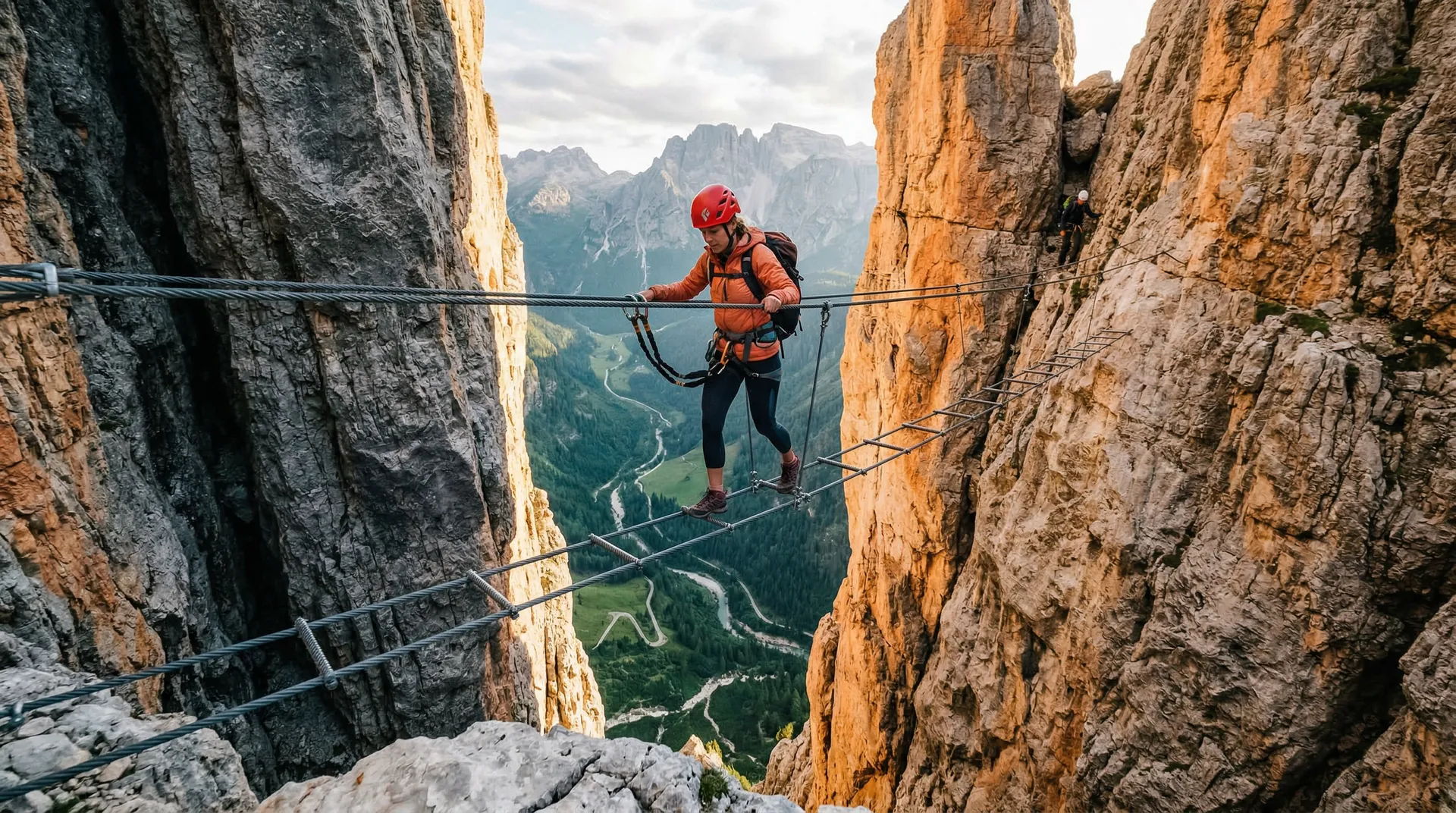
Depending on the route, you may encounter a suspension bridge (vertiginous feel but continuous safety cable), a vertical ladder or a final zip line. The guide warns you before each section and adapts the pace. On an F or PD route, these elements are optional or short.
5. Descent and return (20-45 min)
Most via ferratas end with a hiking trail down. Some offer a zip line or a final abseil. Return to the starting point, hand back gear. Our via ferrata equipment guide details everything that's provided and what you need to bring.
Beginner mistakes to avoid on a via ferrata
1. Pulling with your arms instead of pushing with your legs
The most common mistake. Arms tire within minutes if you haul yourself up. Use your legs as the engine, arms are only for balance and guidance.
2. Choosing a route that's too hard
A K3 for your first outing means you won't enjoy it. Mountain pride comes at a price. An F or PD route gives you time to learn the moves, take in the views and build confidence.
3. Ignoring the weather
A thunderstorm on a via ferrata is a life-threatening emergency: steel cables are lightning conductors. No "let's see how it goes": if weather is uncertain, postpone.
4. Skipping water and snacks
At 1,500 m altitude under effort, dehydration hits fast. 1 litre minimum per person, even for a 2.5-hour outing. An energy bar at the halfway point makes a real difference on the second half.
Budget for a first via ferrata
With a certified guide (recommended for beginners), expect €37 in Ardèche to €100 at Lake Garda for a 4-5 hour route. In Spain, prices drop to €30-60 for guided routes in Alicante or Ronda.
Going independently with rental gear, the budget drops to €15-20 per day (harness + lanyard + helmet). Add hiking shoes if you don't own any (from €50 entry-level). Our via ferrata price comparison breaks down rates by country and format.
Frequently asked questions
Can you do a via ferrata if you're afraid of heights?
Fear of heights isn't necessarily a deal-breaker. On F and PD routes, the exposure stays moderate and you're clipped in at all times. The sensation on a via ferrata is very different from standing on a balcony: you always have footholds and the cable in your hands. Tell your guide and they'll pick a suitable route.
How long does a beginner via ferrata take?
Allow 2.5 to 4 hours for an F or PD route with a guide, all in (briefing, approach, route, descent). Longer routes (K3+) can take 5 to 6 hours.
Do you need to be fit for via ferrata?
Not for a beginner route (F or PD). You need to be able to hike for 2 hours in the mountains and have enough arm strength to hold yourself on rungs. The real key is pushing with your legs and keeping your arms straight.
What is the minimum age for via ferrata?
From age 8 to 10 depending on the route, accompanied by an adult and a guide. The child must be able to reach the rungs (minimum height varies by site) and not be afraid of heights. Family routes (F) are designed for this audience.
See all Via Ferrata offers
231 offers →