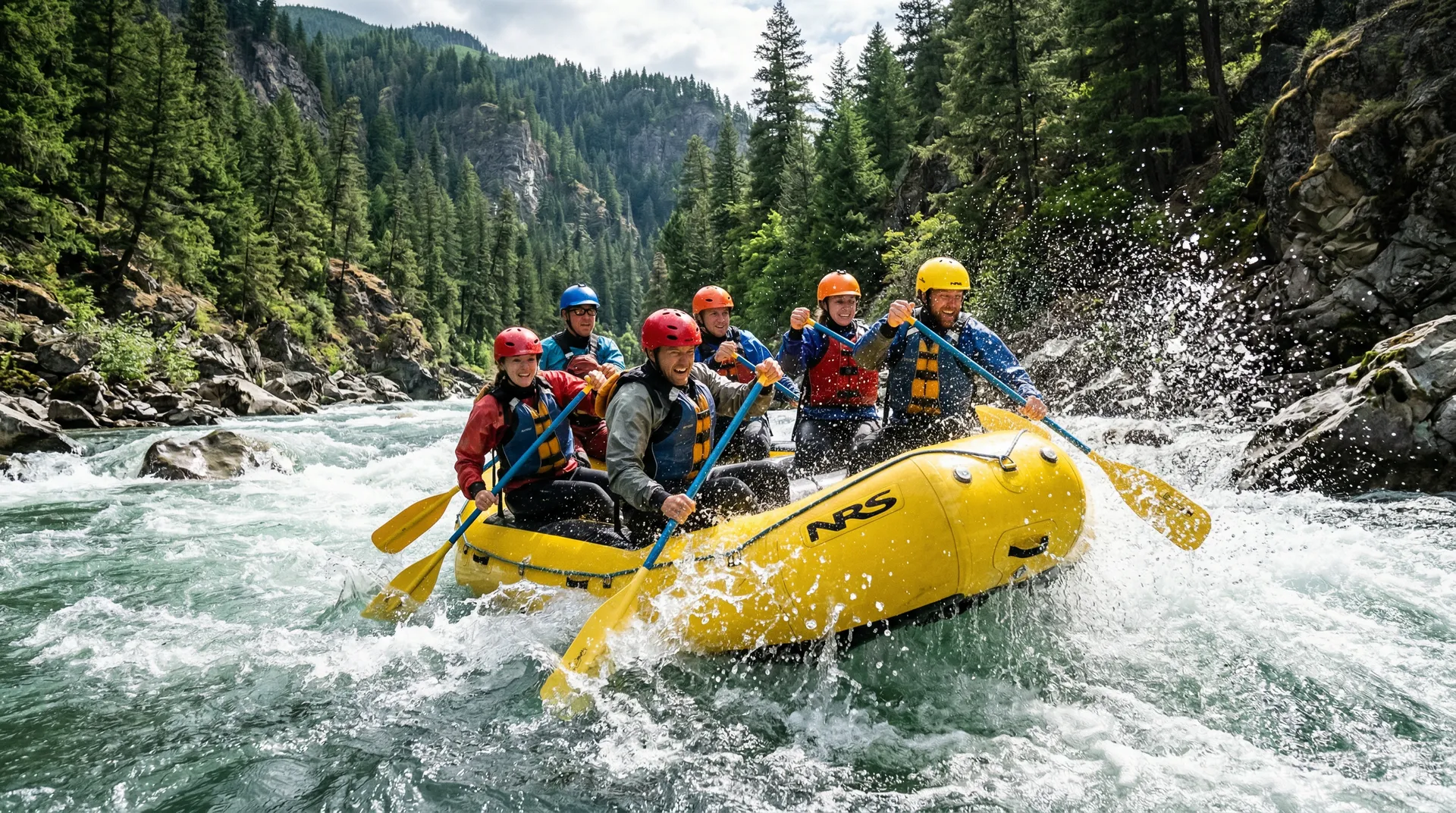
8 people in an inflatable raft, feet braced under the tubes, paddles in a current at 15 km/h: a first white water rafting trip lasts 2 to 3 hours on the water, costs €32 to €90 in France with a guide and requires zero experience. The guide steers from the back, you paddle on their commands. The real decision is the rapids class and the river.
427 offers White Water Rafting
Compare offersWhat is white water rafting?
A raft is a 4 to 8-person inflatable boat, manoeuvred collectively with paddles, steered by a certified guide sitting at the back. You descend a river through rapids (waves, rocks, current) interspersed with calm sections.
Unlike kayaking or canoeing, rafting is a group activity: the crew's coordination makes the difference between a smooth ride and an unplanned swim. Trips run from 1.5 hours (discovery runs) to 4.5 hours (full descents), with 2 to 2.5 hours being typical for a first outing. The season runs from April to October, with ideal water levels in May-June thanks to snowmelt.
Rapids classes: choosing the right rafting level
The international scale rates rapids from Class I (flat water) to Class VI (unrunnable). For a first trip, aim for a Class II to III river.
| Class | Intensity | What it involves |
|---|---|---|
| I | Flat water | Steady current, no waves. Family float. |
| II | Easy | Small waves, simple passages. Accessible from age 6. |
| III | Moderate | Irregular waves up to 1 m, active manoeuvres. Ideal for beginners wanting thrills. |
| IV | Sustained | Powerful rapids, technical passages. Experience required. |
| V | Extreme | Violent current, high risk. Experienced rafters only. |
Class III is the sweet spot for a first time: enough intensity to get the adrenaline flowing, enough control for the guide to manage the descent safely. Rivers like the Soča in Bovec or Scotland's Fort William offer Class II-III sections accessible without experience.
Before the day: preparing for your first rafting trip
Book at the right time
The optimal season runs May to July: river levels peak thanks to snowmelt. By August-September, some rivers drop below navigable thresholds. Book 1 to 2 weeks ahead in peak season (July). Same-day booking is often possible in June.
Pack the right gear
Swimsuit under the wetsuit, closed shoes that stay on your feet (old trainers or water shoes, never flip-flops), and dry clothes for the return. The operator provides a 3-5 mm neoprene wetsuit, buoyancy aid and helmet. Leave a towel in the car.
Eat and hydrate
Eat normally 1 to 2 hours before. Avoid a heavy meal right before: the raft's movement through rapids can cause nausea. Bring a water bottle for after the descent.
What happens on a rafting trip: step by step
1. Welcome and briefing (15-20 min)
Meet at the river base. The guide hands out wetsuits, buoyancy aids and helmets, then explains the paddle commands: "forward", "back", "stop", "hold on". The key rule: always keep one foot wedged under the tube to avoid being thrown out.
2. Launch and warm-up (10 min)
Board the raft on a calm section. The guide gets the crew paddling together to calibrate the rhythm. You practise the commands and learn how to reposition if you slip off the tube.
3. The descent (1.5 to 3 hours)
Alternating calm stretches (recovery, scenery) and rapids (paddling effort, coordination, splashing). On a Class III run, expect 6 to 10 rapids over 8 to 12 km. Each rapid lasts 20 seconds to 2 minutes. Between rapids, the guide explains what's coming and how to react.
It's this rhythm that makes the activity addictive: 3 minutes of calm, 30 seconds of intensity, then the release and the laughter.
4. Falling in
It happens to most beginner crews at least once. Don't panic: the buoyancy aid keeps you afloat. Roll onto your back, feet first to cushion against rocks and let the current carry you until the guide or a crewmate pulls you back in. It's often the funniest moment of the trip.
5. Return and debrief (15-30 min)
Arrival at a beach or bank downstream. Shuttle back to base (included in the price). Hot showers available at most operators. Canyoning is often offered as a complement by the same operators if you're after a second water activity.
Beginner mistakes to avoid when rafting
1. Paddling with your arms instead of your torso
The power comes from rotating your trunk, not your biceps. Turn your shoulders with each stroke. Your arms will tire three times slower.
2. Dropping the paddle in a rapid
Natural reflex when waves hit: grab the raft. Bad idea. The paddle is your best stability tool. Keep hold of it, even through rough sections.
3. Wearing flip-flops or smooth-soled shoes
Your feet slide off the tube, you lose your brace. Result: you're the first one in the water. Closed shoes with grippy soles, even if they come out soaked.
4. Ignoring the guide's commands
When the guide shouts "back", it means now, not in 3 seconds. Crew coordination is the difference between running a rapid cleanly and taking it sideways. Stay alert, especially approaching rapids.
Budget for a first rafting trip
In France, a guided Class II-III descent costs from €32 at Serre-Ponçon to €90 at the Gorges du Verdon for 2 to 3 hours. At Chamonix, expect €45 to €66 for a descent of the Arve. Wetsuit, buoyancy aid, helmet and return shuttle are included.
In Slovenia (Bovec, Soča river), prices range from €40 to €72 for turquoise water famous across Europe. In Switzerland (Interlaken), prices climb to €150 for Alpine rivers.
Realistic budget for a first trip in France: €45 to €65 per person, all included. It's one of the most accessible water sports going.
Frequently asked questions
Do you need to be able to swim for rafting?
Yes, it's recommended. You wear a buoyancy aid at all times, but in case of a fall, being able to swim 25 m in calm water is a minimum. Some operators accept non-swimmers on Class I-II runs only.
What is the minimum age for rafting?
From age 6 on Class I-II runs with a guide. For Class III, the minimum age is typically 8 to 12 depending on the operator. Minors must be accompanied by an adult.
How long does a rafting trip last?
1.5 to 3 hours on the water for a beginner run. Add 30 to 45 minutes for the briefing, gearing up and the return. Allow half a day in total.
What happens if you fall out of the raft?
It's common and rarely dangerous. The buoyancy aid keeps you afloat. Roll onto your back, feet first to cushion against rocks, and let the current carry you. The guide or a crewmate retrieves you within seconds.
See all White Water Rafting offers
427 offers →