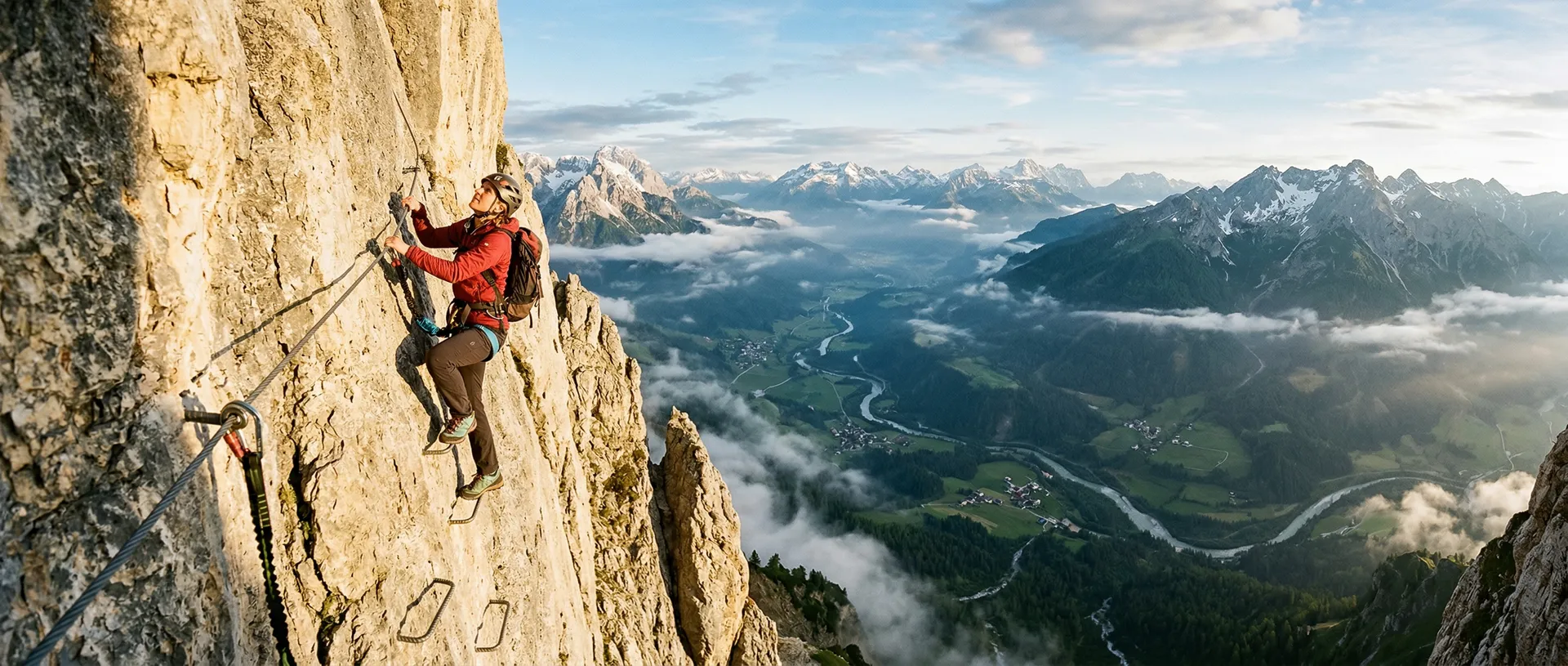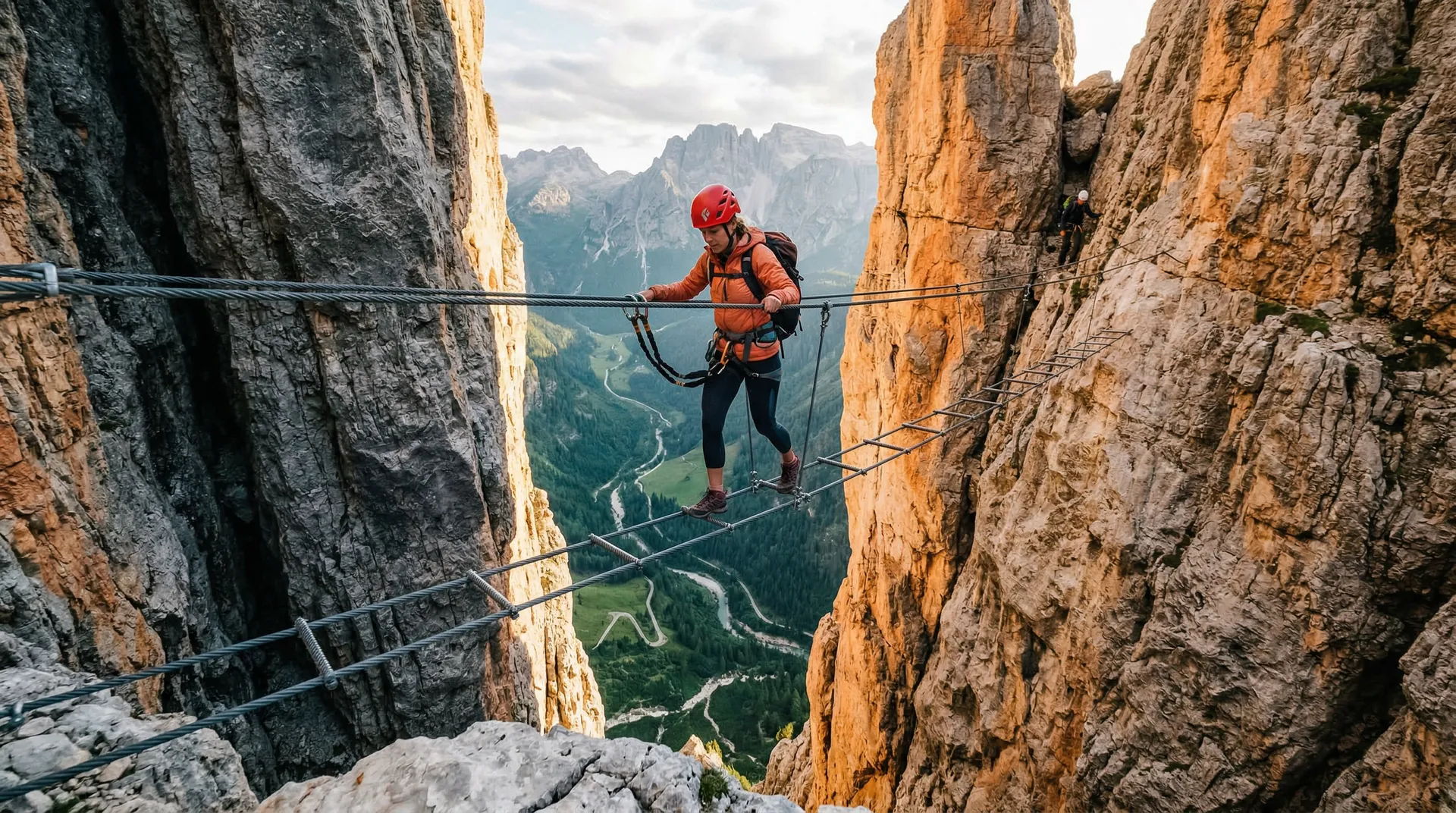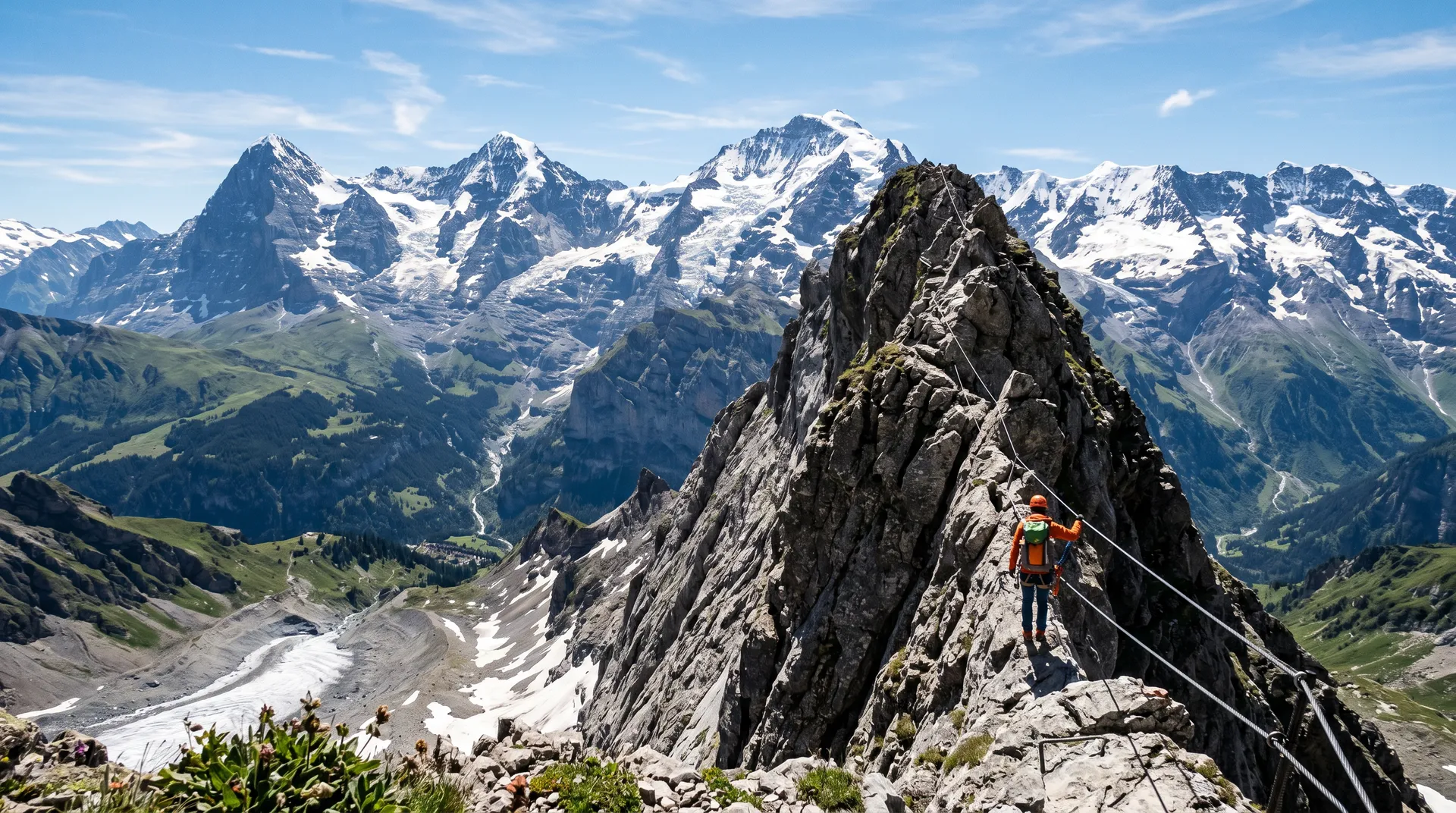
90 equipped routes, six alpine cantons, grades from K1 (family-friendly from age 7) to K6 (seasoned alpinists only): Switzerland packs some of the best via ferrata in Europe. Guided outings cost between CHF 85 and 300, and most routes are open from May to October. Here are 14 via ferrata ranked by difficulty, with grade, duration, elevation gain and budget to help you pick the right one.
231 offers Via Ferrata
Compare offersVia ferrata grades: K1 to K6
Switzerland uses the K scale (Klettersteig), from K1 (family) to K6 (expert climber). Here is how it maps to French and international grades:
| K grade | French grade | Level | What it means |
|---|---|---|---|
| K1 | F (easy) | Family | Wide steps, broad ladders, walkways. From age 7-8 |
| K2 | PD (moderate) | Beginner | Short vertical sections, good holds. From age 10 |
| K3 | AD (fairly hard) | Intermediate | Steep and exposed, arms get a workout. Decent fitness required |
| K4 | D (hard) | Advanced | Vertical, short overhangs, arm strength needed |
| K5 | TD (very hard) | Athletic | Long, demanding, endurance and technique required |
| K6 | ED (extremely hard) | Expert | Minimal fixed gear, trained climbers only |
Below K3, no climbing experience is needed. The conditions required for via ferrata vary significantly from one grade to the next.
Beginner and family via ferrata in Switzerland (K1-K2)
Brunnistöckli, Engelberg (K1-K2)
Open to children from age 8, 45 minutes of cables facing the panorama of central Switzerland. Two variants: the short loop (K1, 200 m elevation gain) and the full route (K2, 1h30). Access via the Brunnihütte cable car. Budget: CHF 85 to 130 for a guided outing. Our beginner via ferrata guide walks you through every step.
Nax / Belvédère, Valais (K1-K2)
Sweeping views over the Rhône Valley and the Valais peaks, all packed into a 1h to 1h30 route. The Belvédère at Nax is one of the highest-rated beginner via ferrata in Switzerland (4.8/5 from 81 reviews). Season: May to November. A solid entry point before stepping up to harder routes in the same region.
Pinut, Flims (K2)
The oldest via ferrata in Switzerland, first opened in 1739 and re-equipped in 1907. 5 hours round trip from Flims in Graubünden, with cave passages and historic ladders. A route that blends alpine heritage with moderate physical effort. Free access, no route fees.
Braunwald, Glarus (K1)
Open to children from age 7, Braunwald offers a dedicated K1 family variant and a progression toward K2-K3 on the same site. Car-free village, access by funicular. The atmosphere is as gentle as the route itself.
4 routes, 4 regions, all accessible with zero prior experience.
Intermediate via ferrata in Switzerland (K3)
Tälli, Gadmen (K3)
The first modern via ferrata in Switzerland (1993) and still one of the most popular. 550 bolts, 600 m of route, 2h30 of progression through Bernese Oberland granite. The signature moment: a 50 m ladder suspended over the void. Guided budget: around CHF 150. Season: June to October.
Gorner, Zermatt (K2-K3)
Three zip lines above the Gorner Gorge, at the foot of the Matterhorn. A 3 to 4 hour route that mixes rock climbing sections with playful elements. One of the few via ferrata that stays open almost year-round (sheltered gorge). Price: CHF 120 to 180 guided. The setting is exceptional, even for Valais regulars.
Eiger-Rotstock (K2)
1h15 of via ferrata with the north face of the Eiger as your backdrop. 260 m of elevation gain, open to children from age 10. The route is short but the panorama is arguably the most iconic of any Swiss via ferrata. Access from the Birg station (Schilthorn). Budget: CHF 100 to 150 guided.
The north face of the Eiger within arm's reach. Hard to beat for a K2 photo op.
Diavolo, Andermatt (K2-K3)
In the Schöllenen Gorge, above the Devil's Bridge. 2h30 of route between history and adrenaline: the gorge has served as a passage to the Gotthard since the Middle Ages. Exposed sections, granite rock, water roaring below. A technical route for a K2-K3.
Advanced via ferrata in Switzerland (K4-K5)
Mürren-Gimmelwald (K3-K4)
610 m of exposure, a Nepalese bridge 100 m above the Lauterbrunnen Valley, and the unusual feature of being a descent via ferrata. 3 hours of route through a grand alpine setting. Mürren is the most popular via ferrata spot in Switzerland (4.8/5, 359 reviews on AllTrails). Guided budget: CHF 149 to 250. Beyond K3, the dangers of via ferrata change in nature.
Allmenalp, Kandersteg (K4-K5)
Spiral staircase, Nepalese bridges, zip line and overhanging sections: Kandersteg packs everything into a single K4-K5 route. 3 hours of demanding progression unlike any other Swiss via ferrata. Reserved for climbers with at least 2-3 K3 routes under their belt.
Rochers de Naye, Montreux (K4-K5)
360-degree panorama over Lake Geneva, the Vaud Alps and the Jura. One of the finest views in Switzerland from a via ferrata route. 1h30 of climbing, graded K4-K5, physically demanding. Access by cog railway from Montreux. Short season: June to September.
Jägihorn, Saas Valley (K3-K4)
Summit at 3,206 m, facing the 4,000 m peaks of Valais. The highest via ferrata in the Western Alps. 5 hours total, physical commitment and altitude. The air thins, the panoramas widen. Not a technical route, but an endurance route at altitude.
3,206 m, thin air, the 4,000 m giants across the valley. The Jägihorn is the altitude via ferrata.
Expert via ferrata in Switzerland: the bucket list (K5-K6)
Daubenhorn, Leukerbad (K5-K6)
The longest via ferrata in Switzerland and in Europe. 2 km of cables, 1,000 m of elevation gain, 8 hours of effort. Graded K5-K6. Reserved for experienced alpinists in excellent physical condition. The route overlooks Leukerbad with a view of the Valais that rewards every metre. Season: July to September only.
Salbit-Höhenweg, Göschenen (K3-K4)
9 hours of royal touring through the Salbit massif, canton of Uri. The 90 m suspension bridge is the signature moment. The route alternates K3 and K4 sections, with sustained commitment throughout the day. A complete alpine adventure, reserved for experienced and self-sufficient climbers.
2 km of cables, 8 hours of progression, 1,000 m of elevation gain. The Daubenhorn is to via ferrata what Mont Blanc is to mountaineering.
Which Swiss via ferrata should you choose?
| Profile | Recommended route | Grade | Guided budget | Why this route |
|---|---|---|---|---|
| Family with children | Braunwald | K1 | CHF 85-120 | From age 7, car-free village, funicular |
| Adult beginner | Brunnistöckli (Engelberg) | K1-K2 | CHF 85-130 | Short, panoramic, 2 variants |
| First K3 | Eiger-Rotstock | K2 | CHF 100-150 | Short, Eiger view, gentle progression |
| Intermediate fun-seeker | Gorner (Zermatt) | K2-K3 | CHF 120-180 | 3 zip lines, Matterhorn backdrop |
| Athletic thrill-seeker | Mürren-Gimmelwald | K3-K4 | CHF 149-250 | Nepalese bridge, 610 m exposure |
| Expert / Bucket list | Daubenhorn (Leukerbad) | K5-K6 | On request | 2 km of cables, 8h, longest in Europe |
On the Italian-speaking side, the via ferrata in Ticino round out the offer with a K4-K5 route on San Salvatore.
Via ferrata in Switzerland: season, budget and gear
The season depends on altitude. Gorge routes (Gorner, Diavolo) open as early as May and some stay open year-round. High-altitude routes (Jägihorn, Daubenhorn) are limited to July through September.
| Item | Budget |
|---|---|
| Guided half-day outing | CHF 85-150 |
| Guided full-day outing (K4+) | CHF 150-300 |
| Self-guided access (no guide) | CHF 0-50 (some routes are free) |
| Via ferrata kit rental (lanyard + helmet + harness) | ~CHF 30 |
Swiss prices run higher than the cost of via ferrata elsewhere in Europe. The gear you need for via ferrata depends on the grade you are targeting.
Frequently asked questions
What is the best via ferrata in Switzerland?
Mürren-Gimmelwald is the most popular (4.8/5, 359 reviews) thanks to its Nepalese bridge and views over the Lauterbrunnen Valley. For pure panorama, Rochers de Naye above Montreux delivers a 360-degree view over Lake Geneva. It comes down to what you are after: the thrill (Mürren) or the panorama (Naye).
Can you do via ferrata in Switzerland with no experience?
Yes. K1 routes like Braunwald (from age 7) or Brunnistöckli in Engelberg (from age 8) are designed for complete beginners. A guided outing includes all the gear and training on progression techniques.
How much does via ferrata cost in Switzerland?
Between CHF 85 for a guided K1-K2 introduction and CHF 300 for a full day on a K4-K5 route. Self-guided, some routes are free (Pinut), others charge an access fee (CHF 15-50). Kit rental: around CHF 30.
When is the best season for via ferrata in Switzerland?
May to October for most routes. Sheltered gorges (Gorner, Diavolo) open earlier and close later. High-altitude routes (Jägihorn at 3,206 m, Daubenhorn) are only accessible from July to September. June and September offer the best balance: stable conditions, fewer crowds than July and August. If the Swiss season is over, via ferrata in Austria stays open later into autumn.
See all Via Ferrata offers
231 offers →