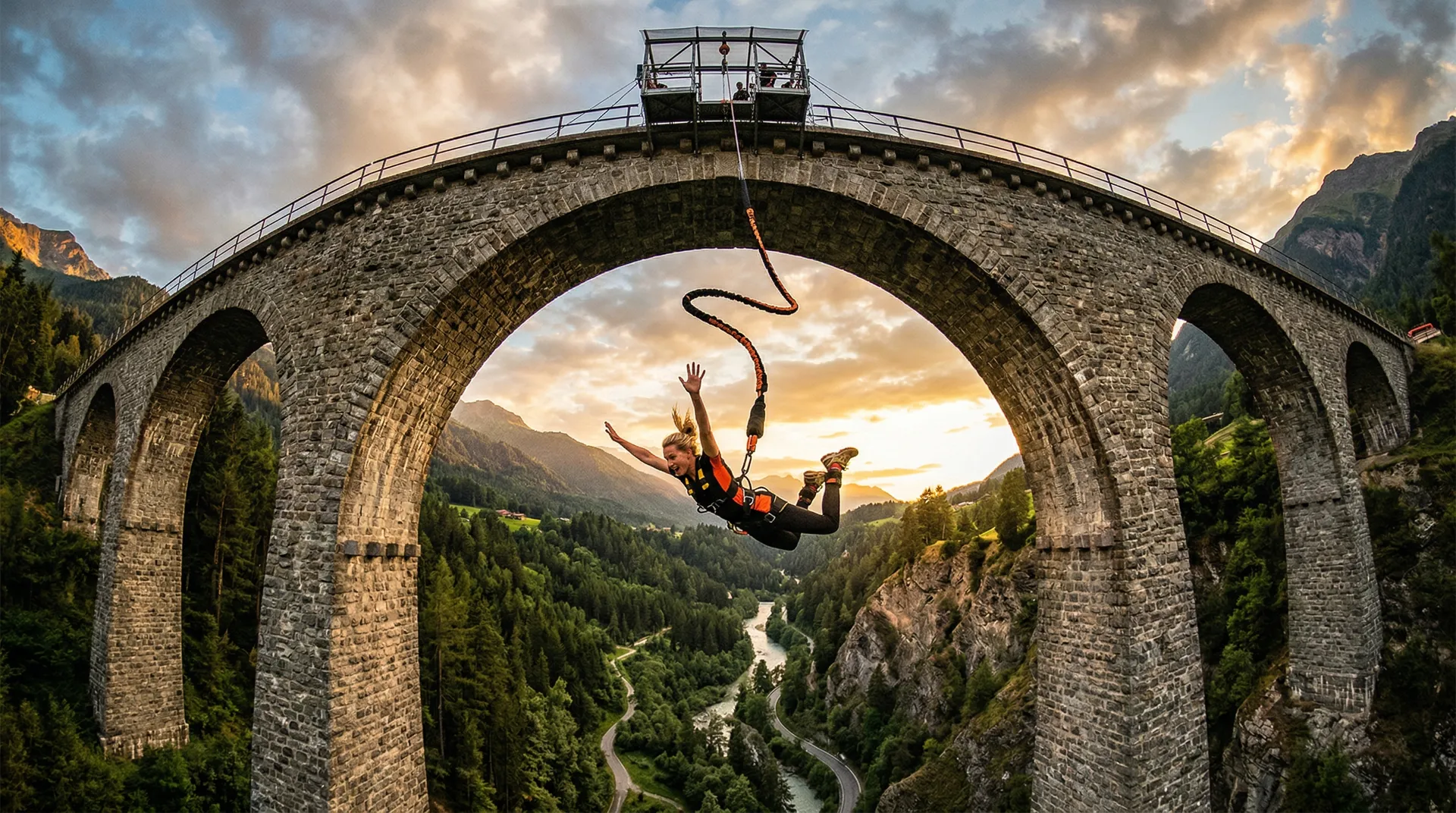
1 death per 500,000 jumps. That's the fatality rate for bungee jumping based on data collected since the late 1980s1. To put that in context, it's roughly equivalent to driving 100 miles by car. The risk is real, but it's measurable and largely preventable. Here's what the numbers actually show, what can go wrong and how to make sure you jump safely.
58 offers Bungee Jumping
Compare offersBungee jumping accidents: what do the numbers say?
Between 1986 and 2002, 18 bungee jumping fatalities were recorded worldwide, just over one per year1. Between 2015 and 2018, 5 additional deaths were documented. Over those same periods, millions of jumps took place across dozens of countries.
Switzerland provides a compelling case study. The Swiss Bureau for Accident Prevention (BPA) reports zero fatalities in 20 years of commercial bungee jumping2. The country requires ISO "adventure tourism" certification and registration with the Federal Office of Sport. Strict framework, clean record.
In France, AFNOR standards NF S52-501 (staff training and procedures) and NF S52-502 (equipment specifications) have governed the activity since 20053. Professional operators follow them consistently.
Zero risk doesn't exist. But in a regulated commercial setting, bungee jumping has one of the best safety records among extreme sports.
The real risks of a bungee jump
Your body experiences 2 to 4 G during deceleration, lasting one to two seconds. Brief but intense. Four risks are worth knowing about.
1. Whiplash and cervical trauma
The sudden deceleration snaps the head forward then back. It's the most commonly reported risk, comparable to a minor car collision. Operators prevent it through pre-jump briefing: chin tucked, arms crossed on your chest. A full-body harness (not ankle straps alone) reduces this risk significantly.
2. Eye injuries
Blood pressure spikes briefly in the head during the inversion phase. This can cause subconjunctival haemorrhages (temporary redness) in some jumpers. Serious cases remain exceptional and mostly affect people with pre-existing eye conditions1.
3. Cord failure
The scenario everyone fears, and by far the rarest. Professional bungee cords withstand loads of up to 2.5 tonnes3. Made of hundreds of sheathed latex strands, they're replaced after roughly 150 jumps or 6 months of use. A weighted test drop is carried out every morning before the first client jump. The rare documented cord failures involve worn-out equipment or unregulated operations.
4. Miscalculated cord length
A cord too long for the bridge height or the jumper's weight: this is the leading cause of fatal accidents in historical data1. Certified operators use a double-check system, one calculation by the rigger followed by an independent verification by another team member. The minimum clearance below the cord's lowest stretch point is 20 metres.
Who should not jump?
Bungee jumping isn't suitable for everyone.
| Contraindication | Detail |
|---|---|
| Heart conditions | Hypertension, arrhythmia, history of heart attack |
| Eye conditions | Glaucoma, retinal detachment, recent surgery |
| Neck or back problems | Herniated disc, hip replacement |
| Pregnancy | Absolute prohibition |
| Epilepsy | Risk of seizure triggered by stress and vestibular stimulation |
Weight and age: most operators set a minimum of 40 kg and a maximum of 120 to 130 kg. Minimum age ranges from 12 to 16 depending on the country, with parental consent required for minors.
If you're unsure, check with your doctor and let the operator know before jump day.
How to spot a reputable operator
Not all operators are equal. Before you book, check these points.
- Certification: in France, AFNOR NF S52-501/502 compliance. In Switzerland, ISO "adventure tourism" certification and OFSPO registration. In the UK, look for membership in BERSA (British Elastic Rope Sports Association). Elsewhere, ask about the applicable national standard.
- Dual attachment: the jumper must be connected by two independent systems (ankle straps AND body harness). A single attachment point is a red flag.
- Daily test drop: a weighted dummy is launched every morning before the first client jump. Ask whether this is standard practice.
- Professional liability insurance: reputable operators display it on their website or present it on request.
- Regular equipment replacement: cords should be changed after roughly 150 jumps or 6 months.
- Full safety briefing: jump position, safety instructions, what to expect. If the briefing lasts less than 3 minutes, ask questions.
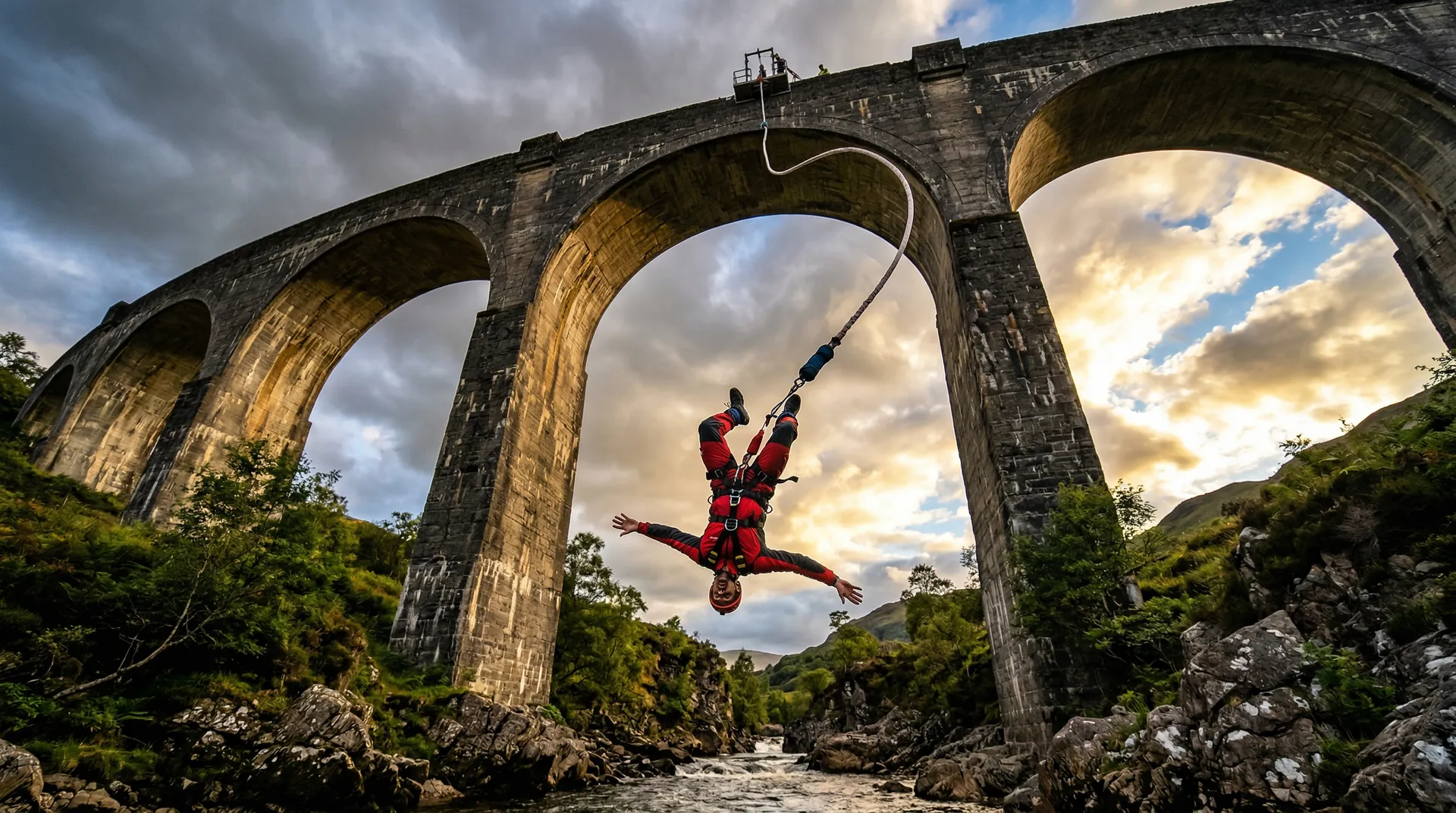
Top-rated spots confirm this standard: at Killiecrankie in Scotland, operators run strict dual-attachment protocols. At Interlaken, Swiss regulation enforces one of the tightest safety frameworks in the world.
For deeper comparisons: is skydiving dangerous? and paragliding danger.
Bungee jumping vs skydiving vs paragliding: how do the risks compare?
Bungee jumping is often compared to the two other big aerial thrills.
| Bungee jumping | Skydiving (tandem) | Paragliding (tandem) | |
|---|---|---|---|
| Estimated fatality rate | ~1 / 500,000 jumps | ~1 / 500,000 jumps | ~1 / 116,000 flights (pilots) |
| Risk exposure time | 3 to 8 seconds | 5 to 7 minutes | 15 to 45 minutes |
| G-forces | 2 to 4 G | 1.5 to 2 G | < 1.5 G |
| Primary risk | Cervical, ocular | Landing | Weather, turbulence |
Bungee jumping compresses the physical stress into a few seconds. The risk window is far shorter than skydiving or paragliding, which partly explains why accidents are so rare.
Frequently asked questions
Can you die bungee jumping?
The risk exists: 18 fatalities recorded worldwide between 1986 and 2002, roughly 1 per year. The estimated rate is 1 per 500,000 jumps. With a certified operator and inspected equipment, the risk is comparable to driving 100 miles by car.
Is bungee jumping bad for your back?
The deceleration (2 to 4 G) loads the spine for one to two seconds. For a healthy person, the risk is minimal. However, anyone with a herniated disc, severe scoliosis or spinal implants should avoid it.
Is there a weight limit for bungee jumping?
Most operators set a limit between 120 and 130 kg. The minimum is usually 40 kg (the cord needs a minimum tension to work properly). The cord is calibrated for a specific weight range: going outside that range makes the length calculation unpredictable.
What happens if the bungee cord snaps?
Professional cords withstand 2.5 tonnes of pull. Made of hundreds of latex strands, they don't snap all at once: even if a few strands break, the cord holds. Every documented case of total failure involved non-professional equipment or unregulated operations. At a certified site, cords are replaced well before reaching their limits.
Sources
- Mei-Dan O. et al., The Epidemiology of Injury in Bungee Jumping, BASE Jumping, and Skydiving, Karger, Medicine and Sport Science, 2012.
- Swiss Bureau for Accident Prevention (BPA), Bungee jumping safety guidance, bfu.ch, 2024.
- AFNOR, Standards NF S52-501 and NF S52-502, Bungee jumping activities, 2005.
See all Bungee Jumping offers
58 offers →