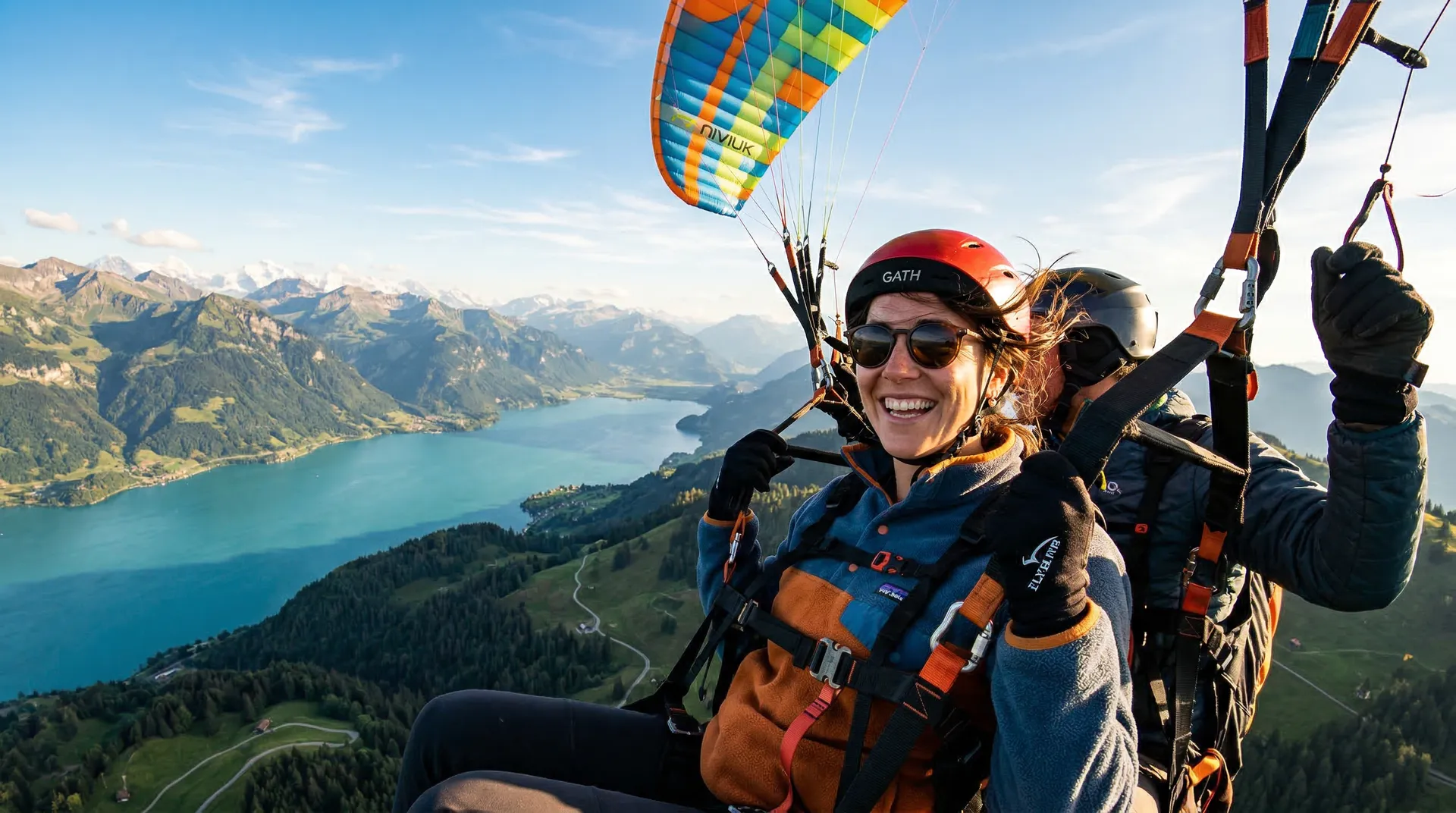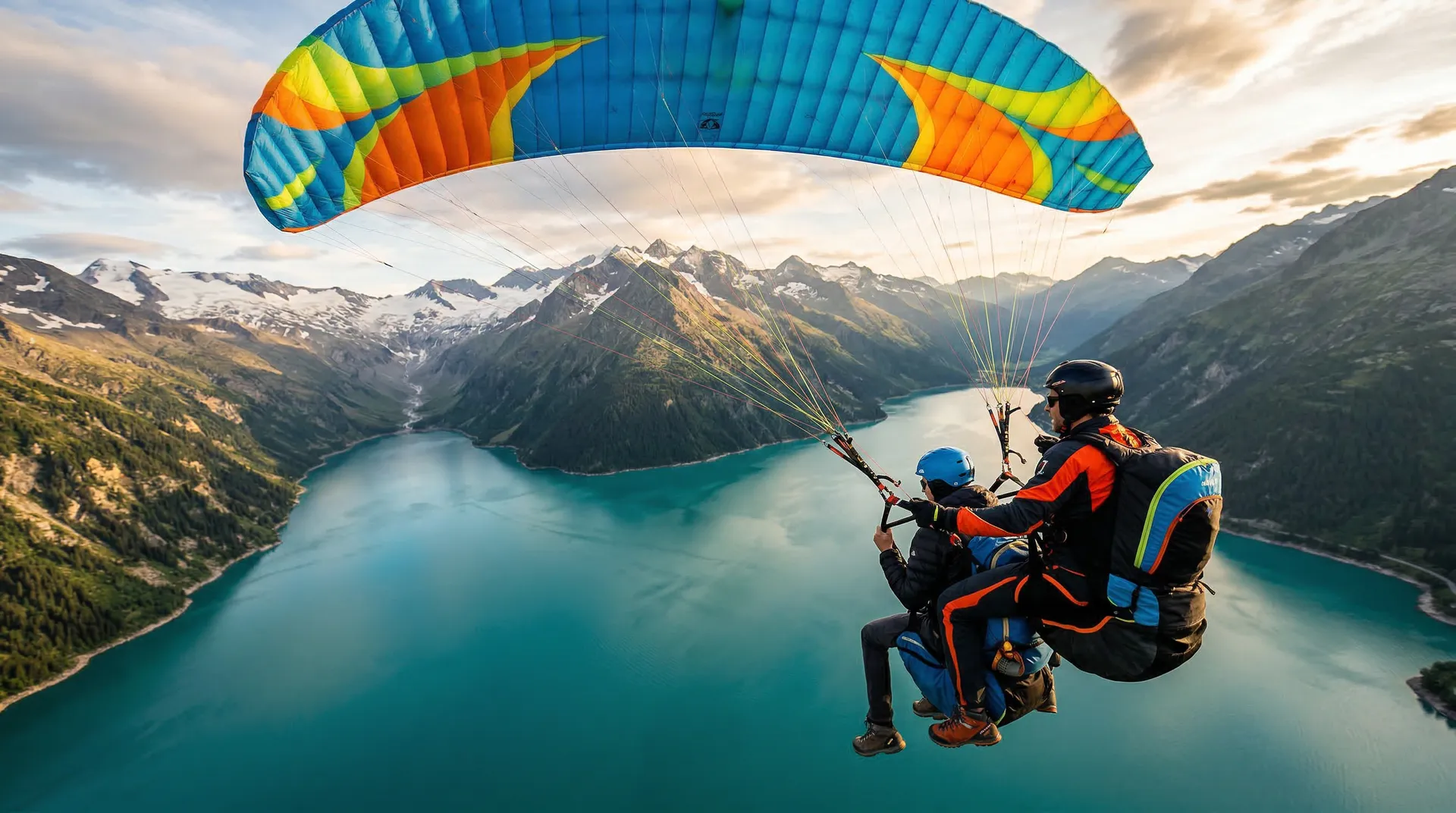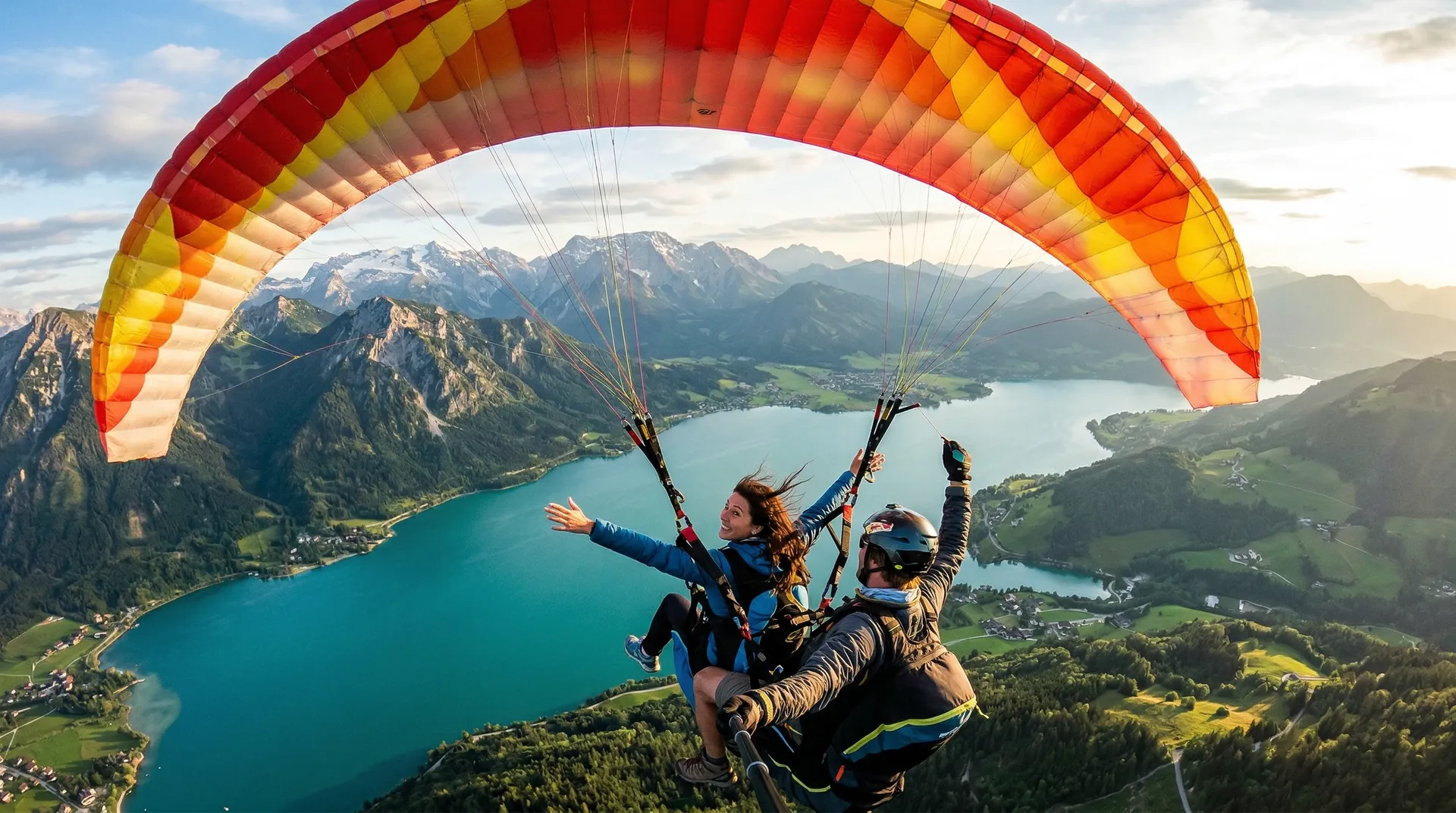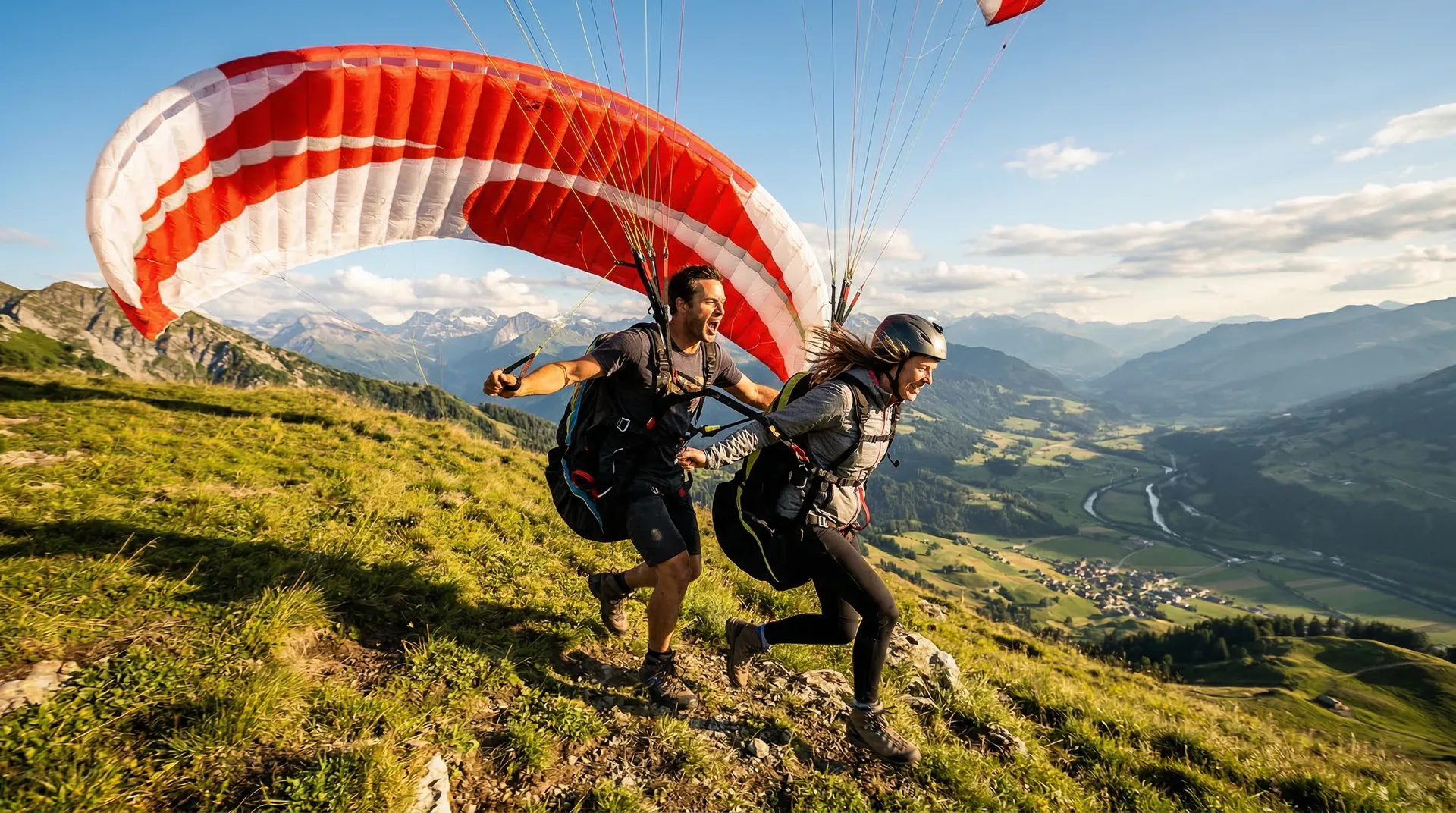
You sit in a harness, a pilot stands behind you, and three running steps later the ground drops away. That is tandem paragliding in its simplest form. No engine, no previous experience, no licence. A discovery flight typically lasts 10 to 15 minutes and costs €70 to €120 across most European sites. Longer thrill flights stretch to 35 minutes and open up aerobatics if you want them. Over 300 offers are available across 19 countries, from the cliffs of southern Turkey to the Swiss Alps, so the hardest part is picking where to go.
This guide covers every practical question: what the flight actually involves, what to wear, when to book and where to fly for the first time.
305 offers Paragliding
Compare offersWhat happens during a tandem paragliding flight?
1. The briefing
Your pilot meets you at the take-off site 15 to 30 minutes before the flight. They check the wind, explain the take-off procedure and fit your harness. You will get one clear instruction: run forward when they say go. Do not stop, do not sit down, do not grab the lines. That is genuinely all you need to do.
Most operators provide a helmet. Some include a GoPro or offer one for rent. Ask before you arrive so you know whether to bring your own camera.
2. Take-off
Take-off is the moment that scares people the most, and it lasts about five seconds. The pilot inflates the wing behind you, you take three to five brisk steps downhill and the canopy lifts you both off the ground. There is no jump, no cliff edge, no freefall. The transition from running to flying is so smooth that most first-timers laugh out of pure surprise.
Wind conditions determine the exact technique. On a calm day you run a few metres. In stronger wind the canopy fills almost instantly and you barely need to move.
3. The flight
Once airborne you sit back in the harness like a reclined chair. Your hands are free. You can take photos, film, or simply look around.
Pilots use thermals (rising columns of warm air) to gain altitude and ridge lift along mountainsides to extend the flight. A discovery flight covers 10 to 15 minutes of airtime. If you booked a longer flight, expect 20 to 35 minutes with possible spirals, wingovers or other manoeuvres if you ask for them. The pilot will always check first.
Communication is easy. You are sitting right in front of your pilot and can talk at normal volume.
4. Landing
The pilot flies a landing pattern into the wind and flares the canopy a few metres above the ground. You stand up in the harness and take a couple of steps on touchdown. Most landings feel like hopping off a low wall. In strong conditions you might slide in on your backside, which looks ungraceful but is perfectly standard.
The whole experience from briefing to landing takes about one hour, sometimes 90 minutes at busy sites.
Do you need to worry about vertigo or motion sickness?
Vertigo is a fear triggered by heights when you can see a physical reference point (a balcony rail, a cliff edge). In a paraglider you are floating in open air with no fixed reference below your feet. The vast majority of people who suffer vertigo on balconies feel completely fine under a wing.
Motion sickness is a different question. Turbulent air, tight turns and aerobatic manoeuvres can trigger nausea in sensitive people. If you know you get carsick easily, tell your pilot before take-off. They will fly smooth, wide turns and avoid spirals.
Statistically, tandem paragliding has a strong safety record. Pilots hold professional certifications and fly the same sites hundreds of times per season. For a deeper look at risk factors, read the paragliding risk guide.
What to wear for a paragliding flight
At take-off altitude (typically 800 to 1,500 m above the landing zone) it is noticeably cooler than in the valley. Even in July, budget for a 5 to 10 °C drop.
Summer (May to September)
- Trainers or light hiking shoes that lace up (no sandals, no slip-ons)
- Long trousers or leggings (the harness rubs on bare skin)
- A light windproof jacket you can zip up at altitude
- Sunglasses with a strap or cord
- Sunscreen on face and neck
Avoid anything loose or dangling: scarves, open jackets, unsecured hats.
Winter or shoulder season
Flying in the Alps or Pyrenees between October and March means genuine cold at altitude, sometimes below zero.
- Warm hiking boots with ankle support (take-off sites can be icy)
- Thermal base layer plus a fleece mid-layer
- Windproof and ideally waterproof outer jacket
- Gloves (thin enough to operate a phone camera if you want footage)
- Buff or neck gaiter
Operators in Zillertal and Interlaken fly year-round and will advise on specific kit when you book.
When is the best time to fly?
Spring and summer (April to September)
This is peak season across the Alps and most of continental Europe. Thermals are strongest between late morning and mid-afternoon, which means longer flights and more altitude gain. Annecy, Interlaken and Innsbruck all run at full capacity from May to September.
Book at least a week ahead during July and August. Popular sites sell out fast.
Autumn and winter
The season does not stop in October. Mediterranean and Atlantic sites fly well into November. The Canary Islands and Alicante (from €65) offer reliable conditions year-round thanks to coastal thermals and mild temperatures.
In the Alps, winter flying is spectacular on clear days but depends heavily on weather windows. Fewer operators run, fewer tourists compete for slots and prices sometimes drop. Check the conditions guide for details on wind, rain and cloud limits.
Best spots for a first tandem flight
| Spot | Country | From | Offers | Character |
|---|---|---|---|---|
| Interlaken | Switzerland | €191 | 7 | The bucket-list flight. Lakes, glaciers, Eiger panorama. Premium pricing, worth every cent. |
| Zillertal | Austria | €90 | 10 | Best value in the Alps. Wide valley, gentle thermals, perfect for nervous first-timers. |
| Annecy | France | €76 | 13 | Classic lakeside launch from Col de la Forclaz. Stunning in summer, busy at weekends. |
| Innsbruck | Austria | €109 | 6 | Fly above a capital city with Alpine peaks on every side. Short transfer from town. |
| Alicante | Spain | €65 | 4 | Cheapest option on this list. Coastal flying, warm year-round, great for winter escapes. |
| Lake Garda | Italy | €120 | 3 | Launch from Monte Baldo with lake views. Cable car access makes logistics easy. |
| Chamonix | France | €120 | 5 | High-altitude flights with Mont Blanc as a backdrop. For those who want drama. |
Interlaken is the most iconic site in Europe and frequently tops best-paragliding lists worldwide. If budget allows, it delivers. For a breakdown of pricing across all major European sites, see the paragliding cost guide.
Zillertal deserves a special mention. Ten operators compete in one valley, which keeps prices fair and availability high. The wide, forgiving terrain makes it a favourite among pilots for introducing beginners. Check paragliding in Interlaken or browse all options from our Zillertal page.
Which type of flight should you choose?
Discovery flight (10 to 15 minutes)
The standard first experience. You launch, enjoy the view, glide down. Enough time to relax, take photos and absorb the sensation without it dragging on. Prices range from €65 in Spain to €191 in Switzerland.
If you are unsure whether you will enjoy it, start here.
Thrill flight (20 to 35 minutes)
A longer flight with optional aerobatics: spirals, wingovers, asymmetric collapses (controlled). Pilots use thermals to gain extra altitude, which extends airtime. Expect to pay €20 to €50 more than a discovery flight at the same site.
This option suits anyone who already knows they enjoy the sensation of flight, or anyone who simply wants more time in the air. The extra minutes make a real difference. At 10 minutes you are still processing the novelty. At 25 minutes you start to genuinely feel what flying is like.
Intro course
Some schools offer a half-day or full-day introduction where you handle the wing yourself under supervision. This is not a tandem flight. You launch solo from a training hill (a gentle slope, 10 to 20 m high) and practise ground handling, inflation and short glides.
A full intro course typically costs €150 to €250 and is the first step if you want to eventually fly solo. It does not replace the tandem experience though. Do both.
Frequently asked questions
How long does a tandem paragliding flight last?
A discovery flight lasts 10 to 15 minutes of airtime. Thrill or performance flights run 20 to 35 minutes depending on conditions and the package you book. Add 15 to 30 minutes for the briefing and gear-up, plus travel time to the take-off site. Budget about 90 minutes total from meeting point to landing.
Is there a minimum age or maximum weight?
Most operators accept passengers from age 5 or 6 (with parental consent) up to no fixed upper age limit. Weight limits vary by operator and wing size, but the typical range is 25 kg to 110 kg. Some pilots fly with passengers up to 120 kg using larger wings. Always declare your weight accurately when booking so the pilot can select the right equipment.
Is the video included in the price?
It depends on the operator. Some include GoPro footage in the base price, others charge €20 to €40 extra. A few let you bring your own camera with a secure strap. Check the listing details before you book. If video matters to you, filter for offers that include it.
Can you fly solo on your first flight?
Not legally, no. Solo paragliding requires a pilot licence, which takes 5 to 10 days of training (ground handling, theory, supervised solo flights) and costs €800 to €1,500 depending on the country. A tandem flight requires zero training because the certified pilot handles everything.
See all Paragliding offers
305 offers →