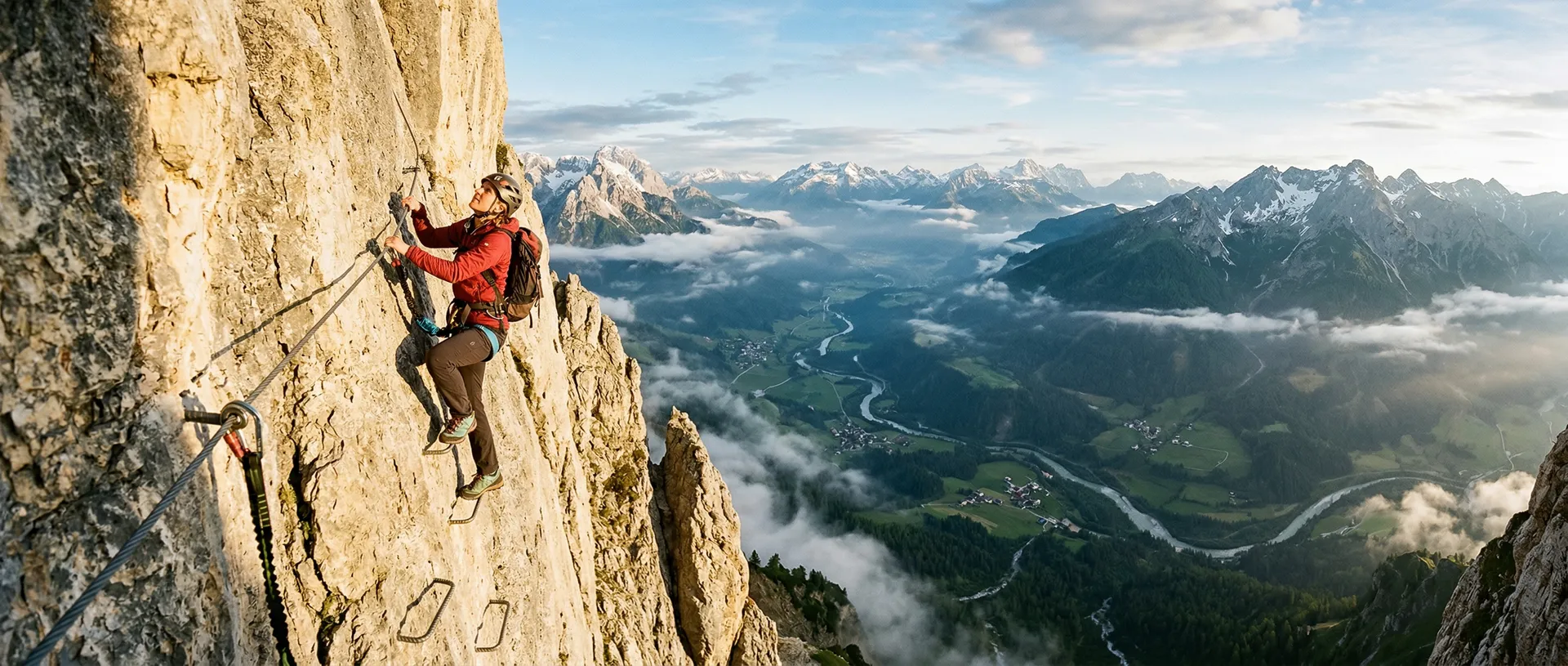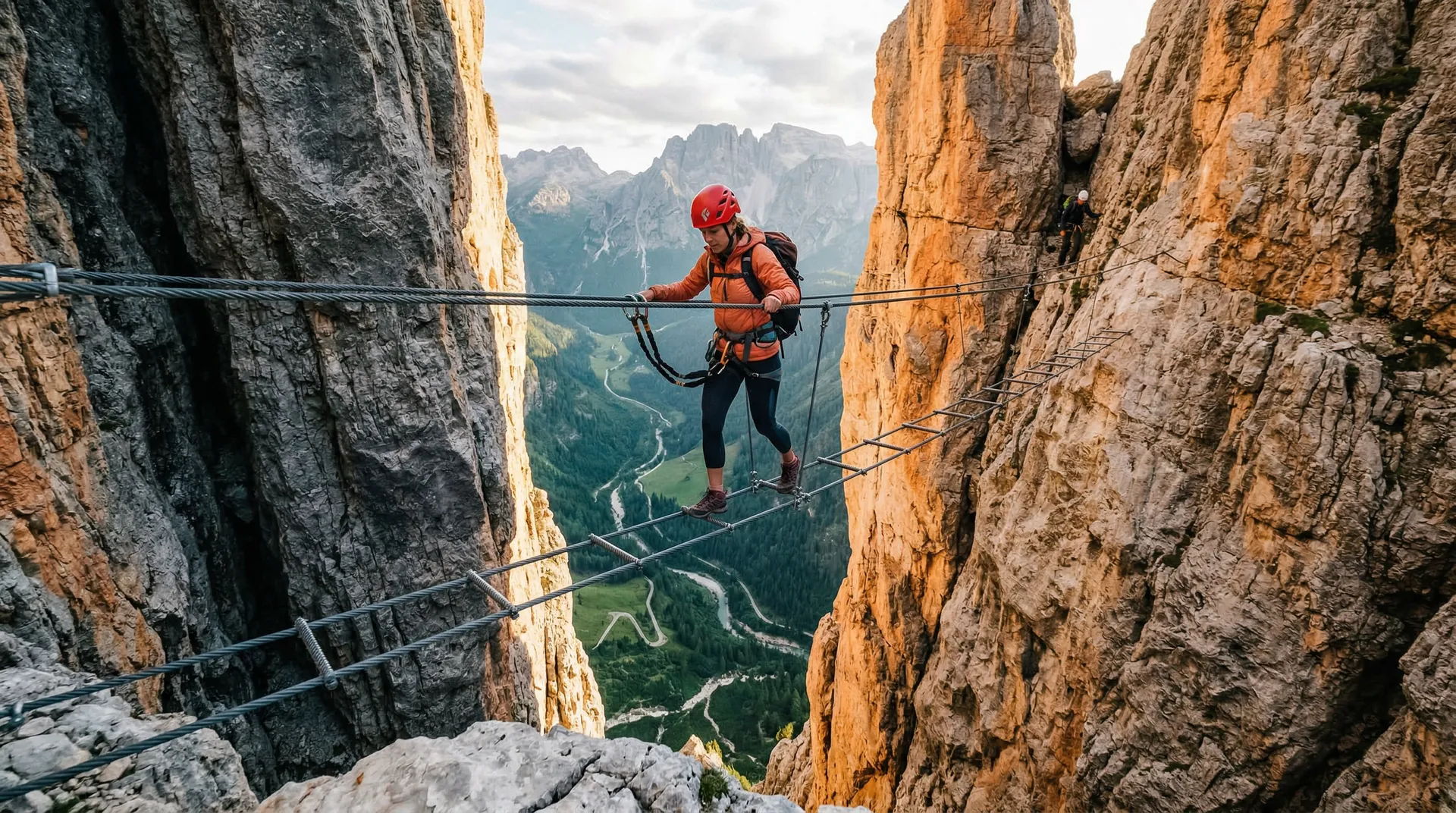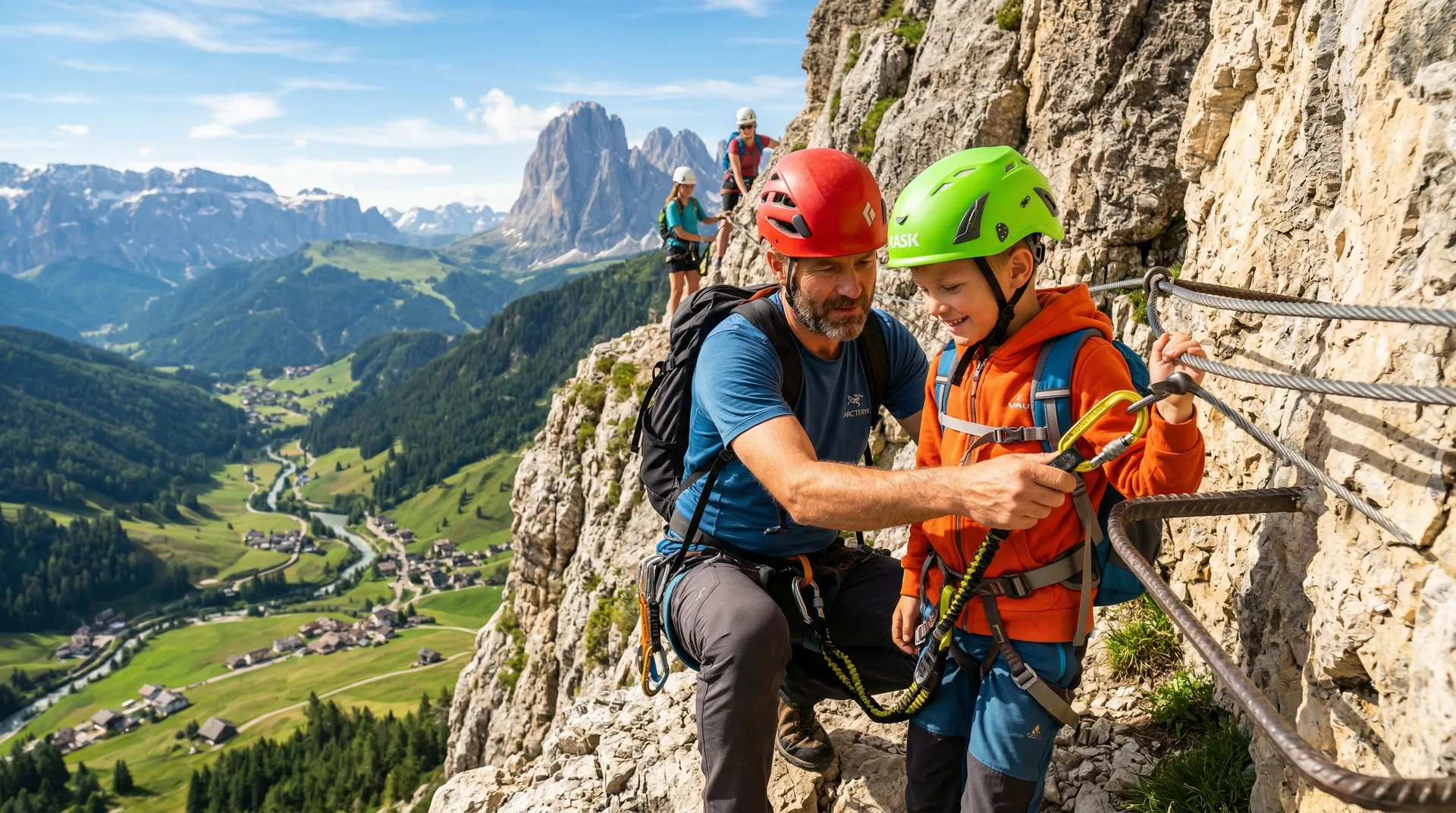
Via ferrata is accessible from age 10 and 40 kg, provided you have reasonable fitness and don't suffer from severe vertigo. F-grade (easy) routes are designed for beginners: 2 to 3 hours of moderate effort, feet on steel rungs, clipped to the safety cable at all times. The real criteria are the ability to hike in the mountains for 2 hours and to handle heights without freezing.
231 offers Via Ferrata
Compare offersVia ferrata conditions at a glance
| Requirement | Condition | Details |
|---|---|---|
| Minimum age | 10 years (F-grade routes) | 8 years on specific children's routes |
| Weight | 40 kg min, 105-120 kg max | Energy absorber limits (EN 958 standard) |
| Height | ~1.30 m min | To reach rungs on standard routes |
| Fitness | Moderate | Able to hike 2h in the mountains |
| Medical certificate | Not required | For guided outings |
| Pregnancy | No | Not recommended at any stage |
These conditions cover guided outings. Going independently, the same criteria apply but without a guide to adjust the pace.
Via ferrata age limits: minimum and maximum
What's the minimum age?
From age 10 on F-grade routes with a guide. The child must weigh at least 40 kg: below that, standardised energy absorbers don't function correctly in a fall. Some sites offer children's routes from age 8 with specific gear, but that's the exception.
Between 10 and 14, most F and PD routes are accessible. Height matters as much as age: the child must be able to reach the rungs, spaced 30 to 50 cm apart on standard routes.
Is there a maximum age?
No official limit. Via ferrata is a low-impact mountain sport, suitable for participants in their 60s and beyond on F and PD routes. The key is arm strength and the ability to hike on rough terrain. Routes at Lake Garda or in Ardèche are accessible to a wide range of profiles.
Fitness level for via ferrata: how fit do you need to be?
You don't need to be a climber. An F-grade route requires the ability to hike 2 hours in the mountains, climb stairs without excessive breathlessness and have enough arm strength to hold yourself on the rungs.
A practical benchmark: if you can hang from a bar for 20 seconds, an F or PD route is within reach. AD and above (K3+) demand significantly more endurance, arm strength and good altitude tolerance over 3 to 5 hours.
The most common trap is underestimating the approach walk. Some routes require 30 to 45 minutes of uphill hiking before you even reach the start. Our via ferrata beginners guide covers the full experience step by step.
Vertigo and via ferrata: is it a deal-breaker?
Clinical vertigo (inner ear disorder, spinning sensation) is a genuine contraindication. But most people who mention "vertigo" are actually describing a fear of heights. That's not the same thing.
Fear of heights can be managed. On an F-grade route, exposure stays moderate and you always have footholds and the cable in your hands. The sensation is very different from a balcony or a viewing platform: your body is in motion, focused on effort, not frozen facing the drop.
If the fear is strong, start with a short route (1.5 hours max) with a guide who can adapt the pace. A freeze on the wall is harder to manage than an early return on an easy route. Our via ferrata danger guide puts the real risks in context.
Medical contraindications for via ferrata
Heart and respiratory conditions
Effort at altitude (often 1,000 to 2,500 m) combined with the stress component puts strain on the cardiovascular system. Anyone with uncontrolled heart conditions, severe high blood pressure or severe asthma should consult a doctor before committing.
Pregnancy
Via ferrata is not recommended at any stage of pregnancy. Fall risks, impacts against the rock face and wearing a harness across the abdomen are incompatible with pregnancy.
Epilepsy
A seizure on the wall endangers both the participant and the group. The activity is not recommended if epilepsy isn't stabilised by treatment. If in doubt, consult your doctor and inform the guide.
Joints and back
Shoulders and hands are heavily engaged. Severe joint problems (shoulder, wrist, knee) can limit participation. Via ferrata prices include equipment but not assistive devices for joints: better to know your limits before booking.
Which via ferrata grade to start with?
Grades run from F (easy) to ED (extremely difficult). For a first outing, aim for F or PD.
| Grade | Profile | Fitness required |
|---|---|---|
| F | Beginner, family | Hike 2h, moderate arm strength |
| PD | Sporty beginner | Hike 3h, good endurance |
| AD | Intermediate | Regular sportsperson, good arm/shoulder strength |
| D and above | Experienced | Regular training, mountain experience |
An F-grade route at Lake Garda or in Ardèche is the ideal starting point. Our via ferrata equipment guide details what's provided and what you need to bring.
Frequently asked questions
Can you do via ferrata while pregnant?
No. The activity is not recommended at any stage of pregnancy due to fall risks, impacts against the rock and wearing a harness across the abdomen. Guides will refuse participation.
Can you do via ferrata if you're afraid of heights?
Fear of heights (different from clinical vertigo) isn't a deal-breaker on F and PD routes. You always have footholds and the cable in your hands. Start with a short route with a guide and let them know about your apprehension.
Do you need a medical certificate for via ferrata?
Not for guided outings. You'll sign a declaration confirming no major contraindications. If in doubt about your health, consult a doctor beforehand.
What is the minimum age for via ferrata?
From age 10 and 40 kg minimum on F-grade routes with a guide. Below 40 kg, standardised energy absorbers don't function correctly. Some sites offer specific children's routes from age 8 with adapted gear.
See all Via Ferrata offers
231 offers →