Around 40 people die each year in jet ski accidents in the United States, out of 1.5 million registered craft1. Relative to the number of rides, the fatality risk remains very low. The vast majority of serious accidents involve an inexperienced rider, without supervision and often without a life jacket. On a guided rental with a briefing and safety gear, the danger of jet skiing is a different story.
249 offers Jet Skiing
Compare offersJet ski safety in numbers
The most comprehensive data comes from the US Coast Guard, which tracks all recreational boating incidents annually1.
- Around 40 deaths per year recently: jet skis were involved in 8% of the 564 boating deaths in 2023 and 7% of the 556 in 2024
- 600-700 reported injuries per year
- Downward trend: 65-68 deaths per year between 2005-2007, down to 33-46 since 2013
Jet skis make up roughly 12% of the US recreational fleet but account for 20% of reported incidents. The gap comes down to the nature of the machine: high speed (up to 100 km/h), sharp handling and riders who are often first-timers.
For perspective: swimming accounts for about 4,000 drowning deaths per year in the US. Cycling causes around 1,000 deaths annually. Jet skiing, with around 40 fatalities across millions of annual rides, sits in the moderate-risk category.
What actually causes jet ski accidents
Mechanical failure is rarely the issue. In the vast majority of cases, it comes down to rider behaviour1.
1. Collisions
The leading cause of serious accidents. Collisions with another jet ski, a boat, a swimmer or a fixed obstacle (buoy, dock, rock). At 50 km/h on water, a jet ski without brakes takes a long way to stop: when you release the throttle, the craft keeps gliding forward and loses all steering. Some recent models (Sea-Doo, Yamaha) have a brake and reverse: ask at the briefing whether yours does.
That's the most counterintuitive thing for a beginner.
2. Speed and ejection
A rental jet ski reaches 40-60 km/h. Performance models exceed 100 km/h. At those speeds, a wave or a poorly judged turn throws the rider or passenger off. Hitting the water at high speed can cause injuries comparable to falling on concrete.
3. Alcohol and distraction
Alcohol is an aggravating factor in a significant share of fatal boating accidents in the US. Sun, heat and fatigue amplify its effects. Distraction (looking at the scenery, taking a selfie) rounds out the trio of avoidable causes.
Guided rental vs free riding: two different risk levels for jet skiing
This distinction matters. Most accident statistics come from owners or unsupervised renters.
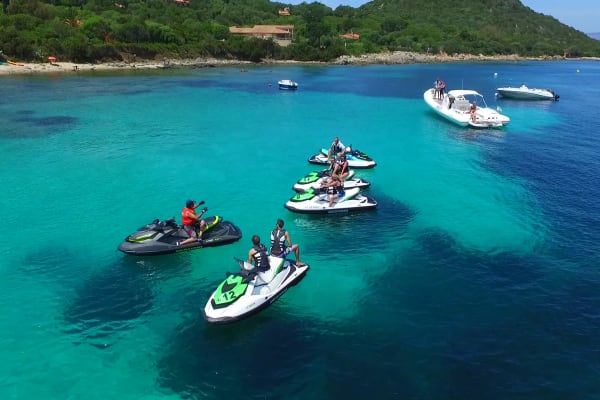
On a guided leisure rental (the most common format for jet skiing in Ajaccio or Antibes), the setup is very different:
- Mandatory 10-15 minute briefing before each ride
- Life jacket provided and checked
- Speed often limited (engine restrictor or guide instructions) on a marked route
- Guide accompanying the group on most safari packages
Residual risk exists (falls, sunburn, muscle fatigue), but serious accidents are exceptional in this setting. The jet ski licence guide covers what's required to ride solo in different countries. On a guided rental, no licence is needed.
How to stay safe on a jet ski?
Six practical habits to minimise risk:
- Wear the life jacket: even if you're a strong swimmer, even in calm water. Most jet ski drownings involve people without a jacket.
- Pay attention to the briefing: that's where you learn the key reflex: releasing the throttle means losing steering. Listen, ask questions.
- Keep your distance: at least 50 metres from other vessels, swimmers and the shore. At 50 km/h, 50 metres take 3.6 seconds to cover.
- No alcohol: zero tolerance before and during the ride. Alcohol impairs reflexes and balance, both critical on a jet ski.
- Check the weather: strong wind, swell and thunderstorms are conditions to avoid. Reputable rental operators cancel outings in poor weather.
- Match your speed to your skill: on a rental, the engine restrictor caps the speed. Riding freely, resist the urge to accelerate until you've mastered turning at low speed.
For the budget side, the jet ski pricing guide breaks down rates by duration and destination.
Frequently asked questions
Is jet skiing dangerous for beginners?
On a guided rental with a briefing and safety gear, the risk is very low. The real danger is for inexperienced riders operating without supervision or riding a friend's jet ski without training. A guided safari is the safest format for a first ride.
How many people die on jet skis each year?
Around 40 deaths per year in the United States in recent years, across 1.5 million registered craft, according to the US Coast Guard. The trend has been declining since 2007. European data is less comprehensive, but the rate relative to the number of riders is comparable.
Do you need to know how to swim to ride a jet ski?
Swimming ability is strongly recommended, even though a life jacket is mandatory. If you're ejected, you'll spend a few seconds in the water before climbing back on. Most rental operators require riders to be able to swim.
What is the biggest risk on a jet ski?
Collision with another craft, a boat or a fixed obstacle. It's the leading cause of serious accidents. Without brakes, when you release the throttle, a jet ski keeps going straight and loses steering. That's the single most important thing to understand before getting on one.
Our best spots
Sources
- US Coast Guard, Recreational Boating Statistics, Annual Report 2024.
See all Jet Skiing offers
249 offers →