The jet ski licence question comes up every summer. The short answer: for a guided tour, you don't need one. To ride solo, rules vary by country. In the UK, there is currently no legal requirement at all, though legislation is pending. Here are the rules by country, age limits, health conditions and alternatives for riding without a qualification.
249 offers Jet Skiing
Compare offersDo you need a licence to ride a jet ski?
It depends on the setup:
- Guided tour or taster session: no licence needed. The instructor holds the qualification, and you ride under their supervision. This covers the vast majority of tourist jet ski experiences.
- Solo riding (self-hire): a licence is required in most European countries. The UK is a notable exception, for now.
In France, jet skis are classified as powered watercraft (VNM). Any craft above 6 HP (4.5 kW) requires the permis cotier to ride unsupervised. In Spain, Germany, Italy and most of the Mediterranean, similar rules apply with local variations.
For a tourist looking to try jet skiing on holiday, a guided tour is the simplest route: no licence, no paperwork, the operator handles everything.
Jet skiing without a licence: guided tours
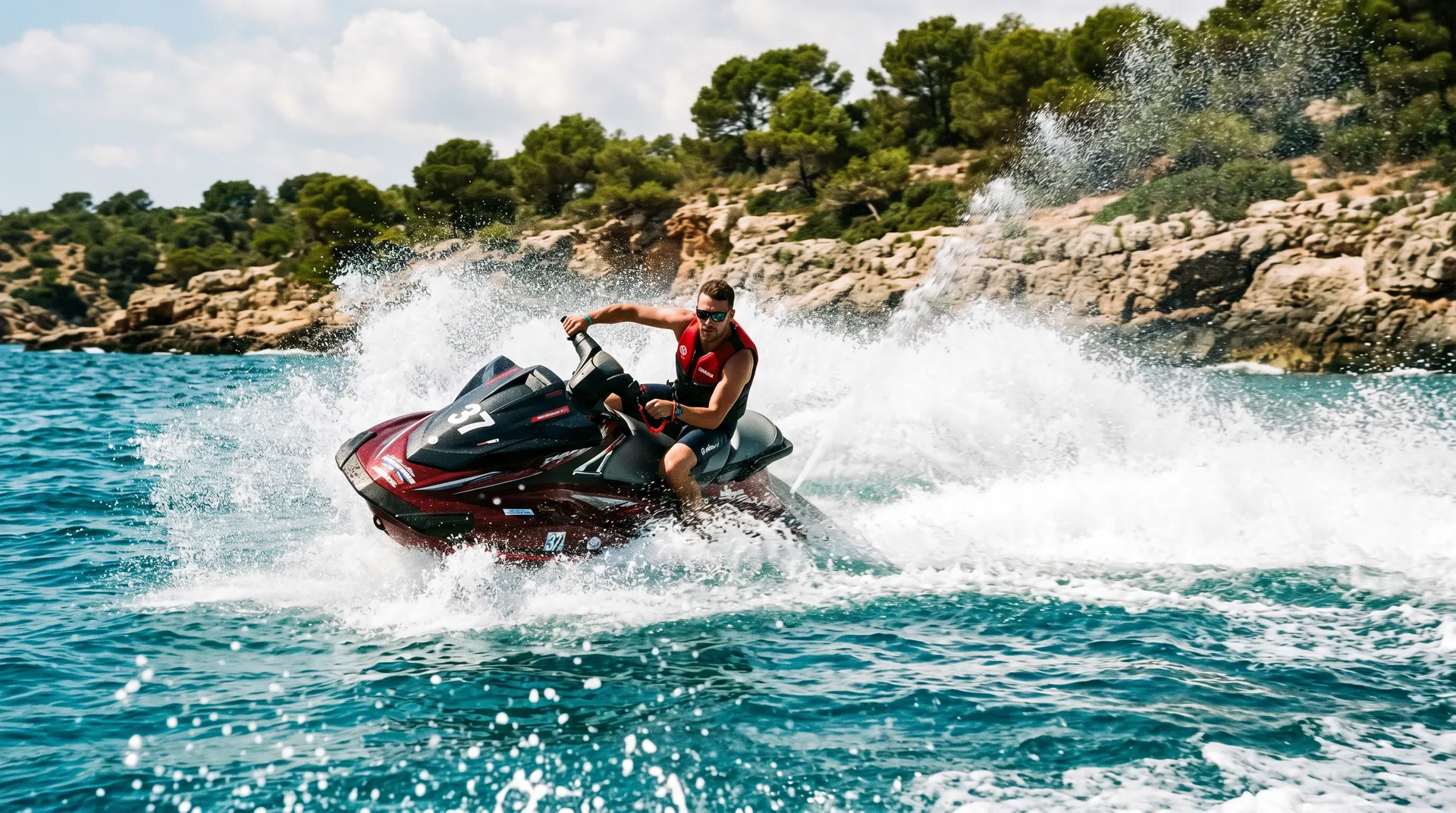
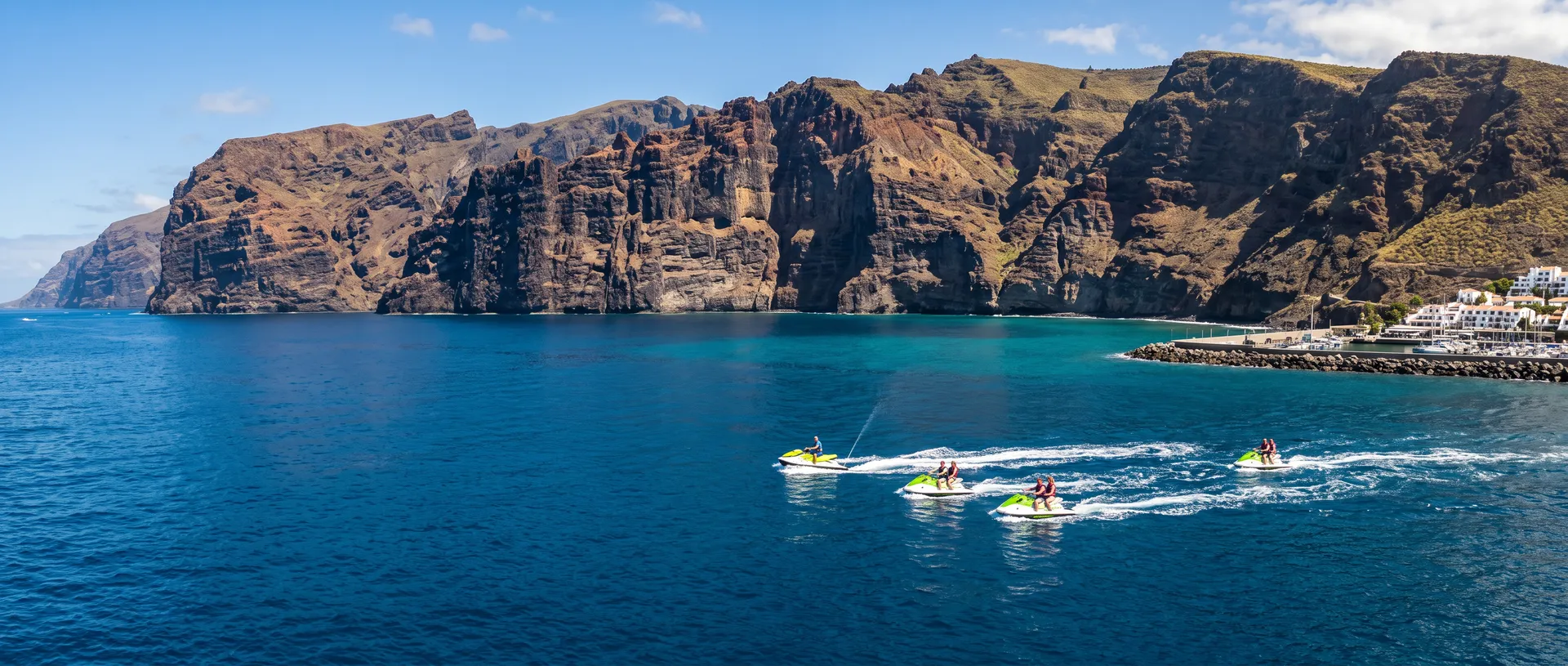
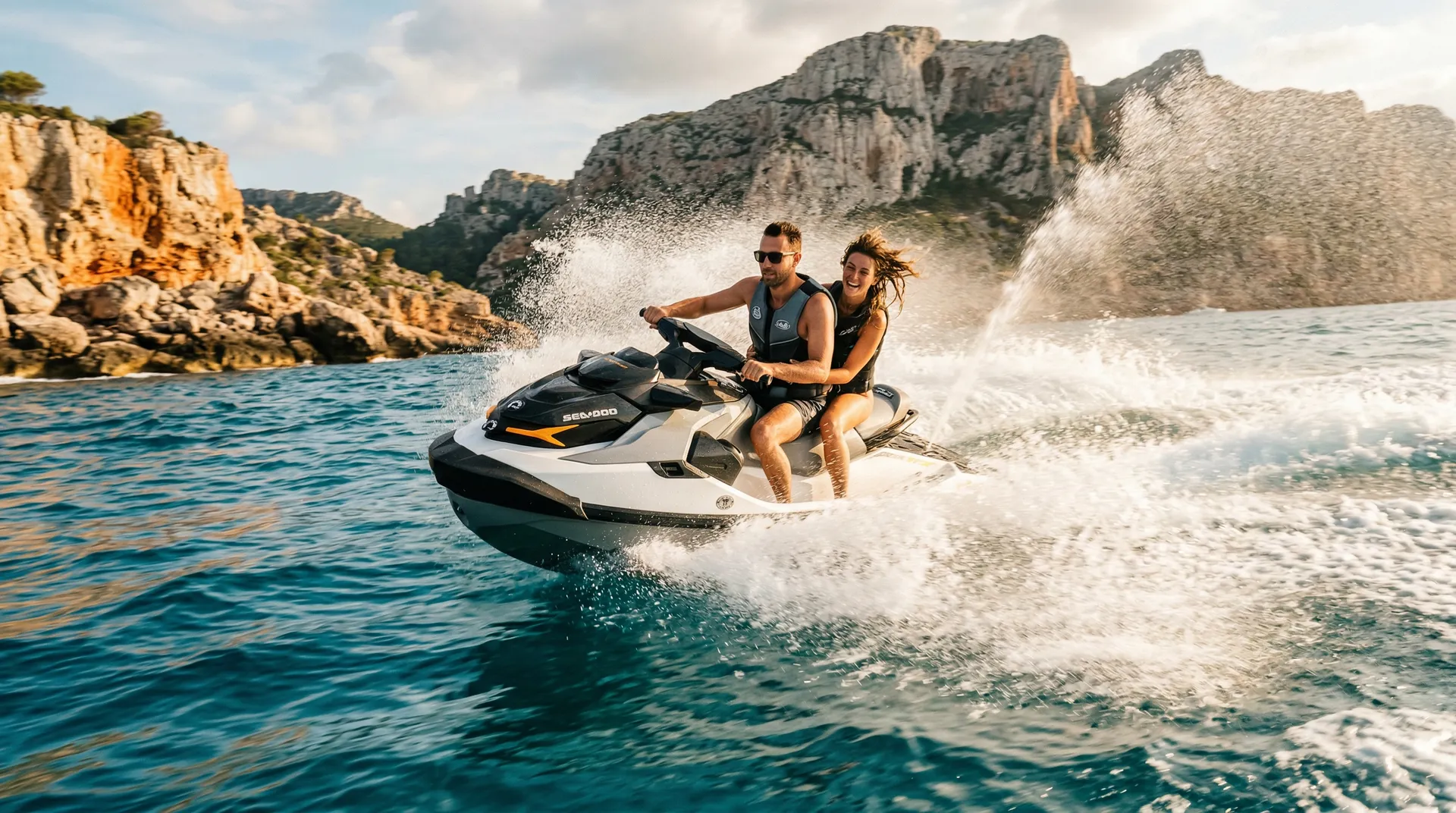
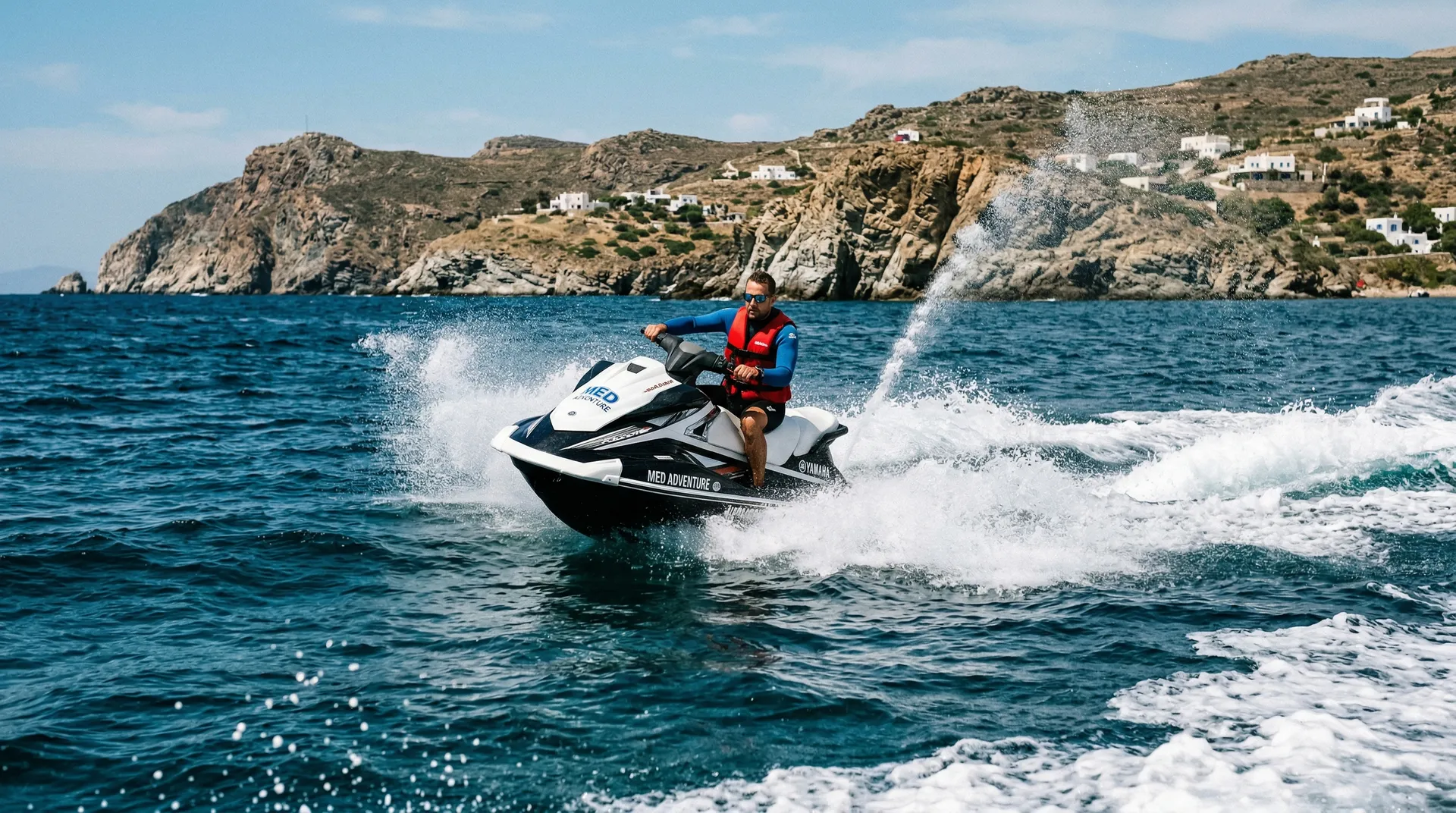
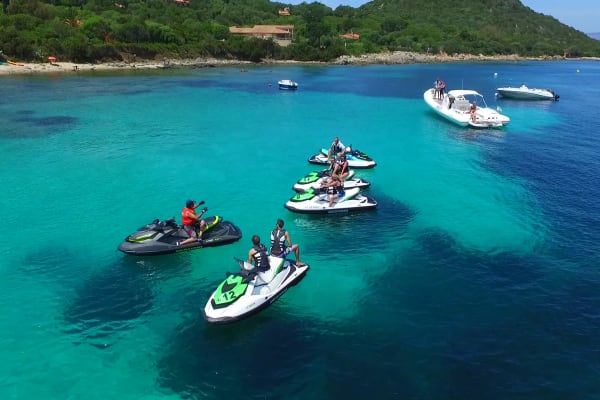
This is the most popular option. A qualified instructor accompanies you along a coastal route while you pilot your own machine. You ride, but within a supervised framework that requires no licence.
Across our listed experiences, 71% are rated “accessible to all” (no particular fitness level required). Sessions last from 30 minutes to 2 hours. Half of the offers cost between €80 and €180.
Three common formats:
- Taster session (20 to 30 min): briefing + first ride, around €66. Perfect for testing the waters.
- Guided coastal tour (1h to 2h): coastal route with swimming stops, €100 to €200. The most requested format.
- Jet ski safari (half-day): long-distance exploration, €200 to €350. For those who want a proper adventure.
Our dedicated guide on jet ski prices breaks down costs by format and destination.
What licence do you need to jet ski solo in the UK?
As of 2026, the UK has no legal requirement for a personal watercraft (PWC) licence. You can ride a jet ski on the sea without any formal qualification. This makes the UK unusual in Europe.
That said, the Royal Yachting Association (RYA) strongly recommends its PWC Proficiency Certificate. The course covers:
- Theory: navigation rules, weather awareness, safety procedures and collision regulations
- Practical: handling, launching, man-overboard drills and close-quarters manoeuvring
- Assessment: practical demonstration (no written exam)
Cost: around €175 to €295 for the full course, typically completed in one to two days.
Legislation is moving. The UK government has signalled intent to introduce mandatory registration and minimum competence requirements for PWC users. Several harbour authorities already require proof of competence before allowing jet ski use in their waters.
For riding in other European countries, the RYA certificate is often accepted as proof of competence, though it is not a formal licence. If you plan to hire a jet ski in France, Spain or Italy, check local requirements before you go.
If you hold a UK Day Skipper or Powerboat Level 2 certificate, these are also recognised by many European hire operators.
On inland waterways, local bylaws apply. Some lakes and reservoirs prohibit jet skis entirely. Always check with the local navigation authority.
Jet ski regulations by country in Europe
Rules vary significantly across Europe. Here is a comparison of the main destinations:
| Country | Licence required? | Min. rider age | Note |
|---|---|---|---|
| UK | No (not yet) | No legal minimum | Legislation pending, RYA PWC recommended |
| France | Yes (permis cotier) | 16 | 6 HP threshold, all jet skis covered |
| Spain | Yes (Licencia de Navegacion) | 18 (16 with parental consent) | 2019 reform, replaces old PWC licences |
| Italy | Yes (patente nautica) | 18 | EU licence accepted |
| Greece | Yes | 16 | International licence accepted |
| Croatia | Yes | 16 | Croatian boat licence or EU recognition |
| Portugal | Yes | 16 | Carta de Marinheiro or EU equivalent |
| Germany | Yes (Sportbootfuhrerschein) | 16 | 15 PS threshold, all jet skis covered |
| Austria | Yes, very restricted | 16 | Banned on most lakes, designated zones on the Danube |
| Switzerland | Banned | n/a | Jet skis are banned on Swiss lakes and rivers |
| Turkey | No | No minimum | Popular destination with no restrictions |
In every country listed except Switzerland, a guided tour with an instructor does not require your own licence. If you hold any EU boating licence, it is generally recognised across other EU member states.
For jet skiing in Santorini or jet skiing in Ajaccio, a guided tour remains the simplest option.
Age requirements for jet skiing: rider and passenger
In the UK, there is no statutory minimum age for jet skiing, though most hire operators set their own limits at 16 for solo riders. In France, the minimum is 16 (with a licence or on a guided tour). Most European countries apply a similar threshold, except Spain (18, or 16 with parental consent).
Children can ride as passengers from age 12 in France (behind a licensed adult). Some operators accept children from 6 to 8 years old on low-speed electric jet skis with enhanced supervision.
Specific children's formats exist: electric jet skis for kids in Guadeloupe, reduced-speed taster sessions in Spain. These are supervised, low-power setups designed for ages 6 to 14. Prices sit around €35 to €60 for 15 to 30 minutes.
Physical and health conditions for jet skiing
Jet skiing works your arms, back and legs. Even though 71% of listed experiences are rated “accessible to all”, certain health conditions are not compatible.
Contraindications
- Back problems (herniated discs, chronic lower back pain): wave impacts put heavy strain on the spine
- Pregnancy
- Cardiovascular disorders
- Epilepsy
Practical limits
- Weight: most machines support up to 150 kg (rider + passenger). Above 100 kg, riding solo is recommended.
- Height: minimum around 1.40 m for a child passenger (to reach the handles)
- Swimming ability: a life jacket is always provided, but basic comfort in the water is strongly recommended in case of a fall
96% of listed experiences are not accessible to people with reduced mobility. The remaining 4% offer specific adaptations, to be confirmed with the operator.
Frequently asked questions
Can you jet ski without a licence?
Yes, by choosing a guided tour or taster session. The instructor holds the qualification and you ride under supervision. This covers the vast majority of tourist jet ski experiences. In the UK, there is currently no licence requirement even for solo riding, though legislation is pending. In most other European countries, a licence is mandatory for unsupervised use.
What is the minimum age for jet skiing?
In the UK, there is no legal minimum, though most operators require riders to be 16. In France: 16 to ride, 12 as a passenger. Children's experiences (electric jet skis) exist from age 6 to 8 in some destinations. In Spain, the solo rider threshold is 18 (16 with parental consent).
How much does a jet ski licence cost?
In the UK, the RYA PWC Proficiency Certificate costs €175 to €295 (recommended, not legally required). In France, the permis cotier costs €350 to €500 in tuition plus €108 to €116 in fees, roughly €450 to €620 total. A guided tour (€80 to €180 for half of the offers) requires no licence at all.
Do you need to know how to swim for jet skiing?
It is not a legal requirement in most countries, but it is strongly recommended. A life jacket is always provided. In the event of a fall, basic comfort in the water is necessary. Most operators ask that you can swim at least 25 metres.
Our best spots
Sources
- UK prices converted from pounds sterling at £1 = €1.18 (ECB, October 2026), rounded to the nearest €5.
See all Jet Skiing offers
249 offers →