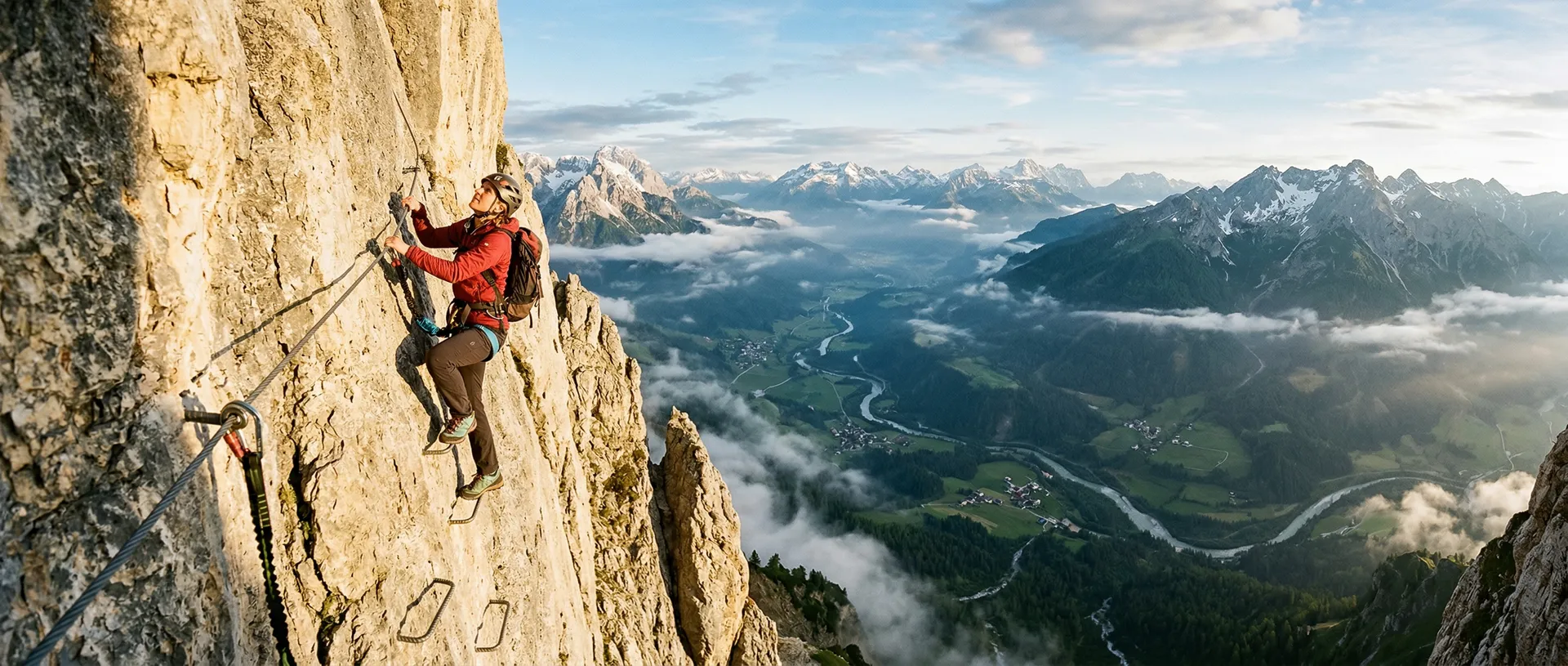
Every summer, the same question comes up before booking a first route: is this actually dangerous? The numbers give a clear answer. In Austria, the country with the highest concentration of via ferrata routes in the world, 62 people died over 10 years out of an estimated several million outings1. The risk is real, but it's very low when gear is used correctly.
What's more surprising is where the real danger concentrates. And the answer isn't what you'd expect.
207 offers Via Ferrata
Compare offersThe Real Accident Numbers in Via Ferrata
The reference study covers 10 years of rescue operations in Austria (2008-2018), the country with the densest network of routes worldwide.
| Data point | Figure |
|---|---|
| People rescued (10 years) | 1,684 |
| Deaths | 62 (3.7% of those rescued) |
| #1 cause of rescue | Exhaustion (42%) |
| #1 cause of death | Falls (76%) |
| Gear misused in fatal cases | 87% |
For perspective: Austria records over 100,000 via ferrata outings per year. 62 deaths in 10 years represents a tiny risk for anyone who respects the basics: gear checked, route matched to ability, weather clear.
In Switzerland, the Alpine Club documented 95 rescue interventions across 17 routes over 5 years: 71% for non-injury blockages, 24% for falls with minor injuries. Two deaths, both involving people who were unclipped at the moment of the fall2.
87% of Austrian fatalities involved improper use of safety equipment. The message is simple: the gear protects you, but only if you use it.
Why Are Easy Routes More Deadly Than Hard Ones?
This is the most counterintuitive finding from the study:
| Grade | Mortality among those rescued |
|---|---|
| A (easy) | 13.2% |
| B | 4.9% |
| C | 0.8% |
| D (difficult) | 4.5% |
| E (very difficult) | 0.8% |
On a grade A route, you feel safe. Some climbers don't clip in at all, or skip checking their lanyard between sections. On a grade D or E route, the verticality forces focus: every move is deliberate, gear gets checked at every anchor point.
Perceived danger protects. Absence of perceived danger exposes.
The Real Dangers on a Via Ferrata
1. Exhaustion (42% of rescues)
A route listed at 3 hours can take 5 if your fitness isn't there. Via ferrata routes in France range from 1.5 hours (grade A, like Clecy at €16.50) to over 4 hours on committed routes in the Pyrenees at €57. When your arms give out halfway through, turning back isn't an option on most itineraries.
The good news: this is the easiest danger to plan for. Pick a route matched to your actual fitness level, not the level you think you have.
The sport is also growing fast beyond the Alps. The UK now has routes at Fort William and in the Lake District, while North America has seen a boom of new installations from Colorado to British Columbia. Wherever you go, the same rule applies: match the route to your real ability.
2. Falls (23% of rescues)
The fall factor in via ferrata is higher than in rock climbing: up to a factor of 5, compared to a maximum of 2 in climbing3. The energy absorber in your lanyard reduces the shock, but only if it's properly connected to the cable. A mispositioned lanyard cancels the entire safety chain.
With gear that meets standards and is used correctly, a via ferrata fall turns into an unpleasant pendulum swing, not an accident.
3. Weather (6% of rescues)
Metal cables are perfect conductors in a thunderstorm. Wet rock becomes slippery. The reflex: check hour-by-hour forecasts on the morning of your outing. If storms are predicted after 2 PM, start early or postpone.
4. Rockfall (2%)
Climbers above you can dislodge loose stones. The helmet isn't an accessory. It's your most basic insurance.
Via Ferrata Solo or With a Guide?
Doing a via ferrata without a guide is legal and common. But a guide changes three concrete things: choosing the right route for your actual level, checking gear at every section, and handling the unexpected (blockage, weather change, injury).
Among the routes we list, a guided via ferrata costs between €28 and €95 in France depending on difficulty and duration. Top-rated routes like the via ferrata at the Gorges du Verdon (€55 to €85, average rating 5/5) include a certified instructor and full equipment.
For your first route, a guide is the best investment. Not just for safety: so you can actually enjoy the route instead of stressing over your gear.
Who Is Most at Risk?
The Austrian study breaks down the profiles:
| Profile | Relative risk |
|---|---|
| Men vs. women | x 2.5 |
| Ages 60-69 | x 2.8 |
| Ages 70-79 | x 3.5 |
| Ages 10-19 | x 0.45 (lowest) |
Men account for 65% of people rescued. Risk increases sharply after 60, often linked to cardiac emergencies on the wall. The 10-19 age group has the lowest risk of any bracket, largely because they're systematically supervised.
The common factor isn't age or gender. It's overconfidence.
How to Choose the Right Route and Minimize Risk
Four checks before you book:
- Grade matched to your real level. First route: stick to A or B. Don't trust the word "easy." Check the elevation gain, duration, and exposure. A route like the via ferrata near Annecy (€69, guided) offers a solid balance for beginners.
- Day-of weather, not yesterday's. Hour-by-hour forecasts. Storms predicted after 2 PM: start early or postpone.
- Gear verified. Y-lanyard with energy absorber, helmet, harness. If the operator provides everything, that's a sign of a serious outfit.
- Honest fitness assessment. 42% of rescues come from exhaustion. If you can't hold a pull-up bar for 30 seconds, a 3-hour route on a rock face will be grueling.
Frequently asked questions
Can you die on a via ferrata?
Yes, the risk exists. In Austria, 62 deaths over 10 years out of 1,684 people rescued. Relative to the millions of annual outings, the rate is very low. 87% of deaths involved improper use of equipment. With gear that meets standards and a route matched to your level, via ferrata remains an activity with manageable risk.
Is via ferrata dangerous if you're afraid of heights?
Mild vertigo usually fades after the first few minutes on the wall. A severe phobia of heights makes the experience painful and can cause a freeze-up. To test your reaction, start with a short grade A route with a guide. You'll know quickly if it's for you.
What should you do if a thunderstorm hits during a via ferrata?
Descend immediately if an escape route exists. If not: unclip from the metal cable (lightning conductor), crouch low away from high points and metal fixtures. This is exactly why checking the weather before you leave isn't optional.
How old does a child need to be for via ferrata?
Most operators accept children from 8 to 12 depending on the grade, always accompanied. The 10-19 age group shows the lowest risk rate of any age bracket, largely because they're systematically supervised. A grade A route with a guide is an excellent first experience.
Sources
- Burtscher M. et al., Accidents on Via Ferratas in Austria, Int. J. Environ. Res. Public Health, 2019.
- Swiss Alpine Club (SAC), Safety and Accidents on Via Ferrata, 2024.
- viaferrata-fr.net, The Fall Factor in Via Ferrata, 2020.
See all Via Ferrata offers
207 offers →