
Skydiving in Sevilla
2 €245–€285 5.0 (37)
At 4,000 meters of altitude, skydiving in Spain delivers a freefall that lasts around 60 seconds before your parachute opens over some of Europe's most dramatic landscapes. Spanish drop zones sit above sun-scorched plains, Atlantic coastlines and volcanic archipelagos, giving each jump a visual signature you won't find anywhere else on the continent. That elevation translates directly to adrenaline: terminal velocity hits roughly 200 km/h before the canopy ride begins.
The Andalusian plains around Sevilla offer flat, wide-open terrain ideal for tandem first-timers, with clear skies for the majority of the year and unobstructed views of the Guadalquivir river valley. Gran Canaria adds an entirely different dimension: jumping over Maspalomas means exiting the aircraft above Atlantic trade-wind thermals with the Saharan dunes of the Parque Natural de Maspalomas visible beneath your feet. On the Spanish Mediterranean coast, Valencia provides a coastal drop zone where the blue arc of the Gulf of Valencia fills your entire field of vision during freefall.
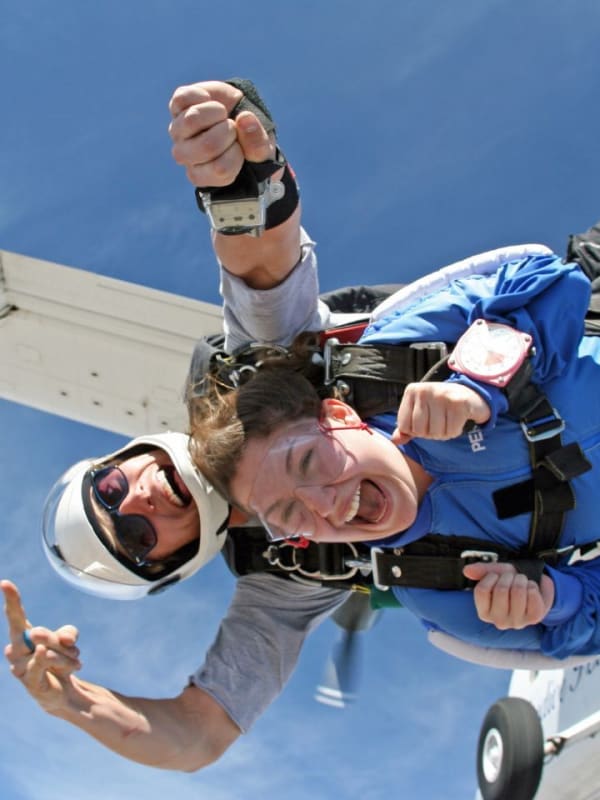


Tandem skydiving in Spain starts at 245 € in Sevilla, rising to 260 € in Valencia and 299 € in Maspalomas, Gran Canaria. Price differences reflect jump altitude, video packages and aircraft operating costs. Most operators include full equipment rental (harness, jumpsuit, helmet) in the listed price, so no additional gear purchase is needed for a first jump.
Skydiving in Spain operates year-round across all listed drop zones, with no worst months on record. The Canary Islands around Maspalomas offer the most stable winter conditions, with mild Atlantic air temperatures and consistent visibility. On the mainland, Sevilla and Valencia peak between April and October when the risk of low cloud cover is minimal and thermals make for a smoother canopy descent.
No prior experience is required for a tandem skydive in Spain. You jump harnessed to a certified instructor who controls the entire descent, from aircraft exit through parachute deployment. A ground briefing of roughly 30 to 45 minutes covers body position, altitude signals and landing procedure. Minimum age is typically 18, and operators in Sevilla and Valencia may require a medical self-declaration form.
Most tandem skydiving operations in Spain jump from 4,000 meters above ground level, delivering approximately 60 seconds of freefall at close to 200 km/h before parachute deployment. In Maspalomas, Gran Canaria, the ocean horizon and the volcanic interior of the island are visible simultaneously at exit altitude, making it one of the most visually distinctive drops available in the country.
Sevilla holds the top review score for skydiving in Spain, rated 5.0/5 across 37 verified bookings. It is also the most affordable entry point at 245 €. Maspalomas, Gran Canaria follows with a 5.0/5 rating from 26 reviews, while Valencia records 5.0/5 from 9 reviews. All three cities currently maintain a perfect rating, reflecting high instructor standards across Spanish drop zones.
Discover our complete guide for your first experience.
Updated September 2026